
the Creative Commons Attribution 4.0 License.
the Creative Commons Attribution 4.0 License.
 | 10 Jul 2025
Formation of mineral-associated organic matter via rock weathering: an experimental test for the organo-metallic glue hypothesis
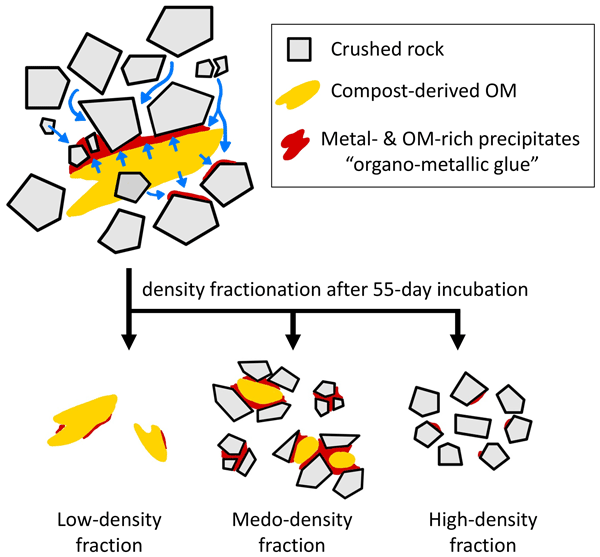
Abstract. Mineral-associated organic matter (MAOM), representing the dominant form of relatively stable C in soil, contains high physicochemical heterogeneity. The co-localization of organic matter (OM) with reactive aluminum (Al) and iron (Fe) phases in various MAOM fractions—across a range of natural and cultivated soils from five soil orders—has led to the “organo-metallic glue” hypothesis. The hypothesis proposes that coprecipitates formed between mineral-derived metals and microbially processed OM act as a binding agent, promoting the formation of stable microaggregates and thereby enhancing soil OM persistence. However, the formation mechanism remains unclear as the observed associations reflect multiple soil processes. We thus designed a simple laboratory experiment to test if the supply of metals and metalloids through rock weathering controls MAOM formation and if the OM-to-metal ratio of the material formed is consistent with complexation, sorptive association, or their mixture (i.e., coprecipitates). Two end-member igneous rocks (granite and basalt) crushed to have 38–75 µm size and, additionally, 20–38 µm size for basalt, as well as river sand (100–300 µm) as control were mixed with leaf compost (powdered to 100–250 µm) as single OM source. The mineral-OM mixtures were incubated aerobically at 30 oC with the natural soil microbial community and subjected to 8 wet-and-dry cycles using artificial rainwater (pH 4.73) over a 55-day experiment. The mixtures were then fractionated by density to examine the formation of meso-density, organo-mineral aggregates (1.8–2.4 g cm–3: MF) by distinguishing it from the compost-dominant low-density fraction (< 1.8 g cm–3: LF) and high-density fraction (>2.4 g cm–3: HF) consisting of the crushed rock. The MF formation assessed as C content was 1.49 ± 0.06 mg C g–1 rock (fine basalt), 1.04 ± 0.08 (coarse basalt), and 0.62 ± 0.06 (granite) over the 55 days, while the net MF mass increase was detected only in fine basalt due to the presence of meso-density materials in the crushed rock (< 7 % by mass). Faster chemical weathering of the fine basalt was indicated by a significant increase in extractable Fe and Al phases, largely in MF, and the highest leaching of Fe and base cations (esp. Na and Ca). The organo-mineral aggregates formed in the fine basalt treatment had the C-to-metal (Fe+Al) ratio of 0.36 ± 0.01 (molar basis), consistent with organo-metal coprecipitation. Further analysis focusing on the two basalt treatments revealed a significant decline in C:N ratios by 23–25 units and enrichment of δ13C and δ15N by 0.9–1.2 ‰ and 0.6 ‰, respectively, in MFs compared to LFs, indicating a strong contribution of microbial N-containing compounds to the MAOM formation. While microbial community composition differed among the treatments, no significant difference was found in qPCR-based bacterial number or species richness. Microscopic analyses using SEM and STXM confirmed the presence of shaking-resistant microaggregates and co-localization of C, Fe, and Al in MF from selected MF samples. Together, our results strongly supported the organo-metallic glue hypothesis and provided laboratory evidence of basalt-induced MAOM formation as well as some insights into early pedogenesis and organo-mineral interactions when applying crushed rock to soils.
-
Notice on discussion status
The requested preprint has a corresponding peer-reviewed final revised paper. You are encouraged to refer to the final revised version.
-
Preprint
(2127 KB)
-
Supplement
(624 KB)
-
The requested preprint has a corresponding peer-reviewed final revised paper. You are encouraged to refer to the final revised version.
- Preprint
(2127 KB) - Metadata XML
-
Supplement
(624 KB) - BibTeX
- EndNote
- Final revised paper


Journal article(s) based on this preprint
Interactive discussion
Status: closed
-
RC1: 'Comment on egusphere-2025-2840', Anonymous Referee #1, 15 Sep 2025
-
AC1: 'Reply on RC1', Kaori Matsuoka, 24 Nov 2025
The comment was uploaded in the form of a supplement: https://egusphere.copernicus.org/preprints/2025/egusphere-2025-2840/egusphere-2025-2840-AC1-supplement.pdf
-
AC1: 'Reply on RC1', Kaori Matsuoka, 24 Nov 2025
-
RC2: 'Comment on egusphere-2025-2840', Anonymous Referee #2, 24 Sep 2025
This article addresses the formation of organo–mineral associations during the early stages of pedogenesis. The study is based on a 55-day incubation experiment of a mixture of leaf compost with crushed rocks. After incubation, a density fractionation step separates the mixtures into three fractions. These fractions were then subjected to various protocols, including chemical extractions (PP, Ox, DC). A broad range of analytical methods was applied to the samples (at day 55 and day 0 for comparison), covering chemical compositions, isotopic (C and N) compositions, bacterial analyses, as well as SEM and STXM imaging. Overall, the results converge towards supporting the “organo-metallic glue hypothesis,” with variations depending on the lithology (granite / basalt / sand) and grain size of the tested rocks.
The experimental and analytical work presented in this article is truly substantial. I believe it is important to emphasize this at the beginning of the review: the dataset is impressive, and these results deserve publication. That said, I also believe the manuscript could be significantly improved in several respects.
Major comments
- Mineralogical approach
In my opinion, the manuscript lacks a sufficiently solid mineralogical perspective. In particular, there is a major conceptual confusion: the authors state that the weatherability of a mineral is directly linked to its chemical composition. This is not entirely correct. Weatherability also depends strongly on (1) the crystallinity of the mineral, and (2) its crystallization temperature (for igneous rocks, as is the case here; see for instance Bowen’s reaction series in geology textbooks). Point (1) is especially critical given the comparison between granite (fully crystallized) and basalt (largely composed of an amorphous glassy phase, hence much more weatherable). I recommend the authors revisit these theoretical aspects of mineral weatherability before revising the sections that address this topic. This is particularly important because the current mineralogical arguments appear somewhat unconvincing. - Mineralogical composition of the samples
Several aspects would benefit from clarification:
- What is the mineralogical composition of the granite? Which ferromagnesian minerals, which feldspars, and in what proportions respective to quartz?
- Why do the hypotheses about the formation of ferrihydrite, goethite, and allophane not rely on direct mineralogical analyses (e.g., comparing MF at D0 vs. D55)? Such information is crucial for a mechanistic understanding.
- What is the mineralogical composition of the sand that justifies its use as a control?
It is unfortunate that the mineral characterization was not performed more thoroughly, as this would provide real added value compared to previous studies on the organo-metallic glue hypothesis.
- Coherence of Methods and Results
The “Materials and Methods” and “Results” sections are not always fully consistent, which sometimes makes the reading confusing. It is essential that these two sections match precisely, especially in a manuscript with such a large dataset. Otherwise, readers may easily lose track. - Figures
It may be strategic to prioritize the most informative figures for the main text, while moving others to the Supplementary Information. This would reduce the number of figures in the core manuscript and allow those retained to be shown at a larger, more legible scale. - Density fractionation yields
I am not fully convinced by the explanations regarding the quantitative mass balance of the density fractionations. The calculations do not seem to compare to pre-fractionation values. This point needs to be clarified (and perhaps discussed, since SPT extractions are often not neutral in terms of yields). - STXM images
I am not fully convinced that the STXM chemical maps demonstrate co-precipitates. The colocalization of C, Al, and Fe—which at this resolution should be observed pixel by pixel—is not clear. Moreover, this colocalization is not shown for basalt (which should provide the most favorable conditions for the glue hypothesis). It is also unclear why Al and Fe were not measured in the basalt samples; at the very least, this should be discussed.
The question of sample thickness is also not addressed: as drop deposits, the sample thickness varies across pixels, and signal intensity is directly linked to thickness. Furthermore, it would be valuable to provide a C spectrum for the leaf compost at D0 and for the LF at D55 as references. These would allow the reader to assess whether the organic matter of the MF fraction underwent transformations detectable by STXM.
Finally, I find the discussion of the nature of the OM in the MF somewhat contradictory:
- On one hand, the authors argue for the presence of “entrapped, less microbially processed OM” (which in my opinion corresponds more to leaf debris from the compost).
- On the other, they argue for results “in line with microbially processed OM in mineral soils.”
Other remarks
To aid the reader, I suggest providing the following in Supplementary Information in tables:
- Masses of the mixtures before and after incubation.
- Mass distributions across each analysis (density fractions, microbial analyses, chemical extractions), and how homogenization was performed before splitting the samples.
- Compositions of the incubated samples before density fractionation.
- Actual masses collected in LF, MF, and HF fractions (so readers do not need to reconstruct mass balances from the bar chart in Fig. 2). This point is very important to my mind.
- C and N concentrations in fractions expressed as mg C (or N) per g fraction, not only per g bulk.
- If possible, the total amount of C mineralized during the 55-day incubation.
Section-specific remarks
Introduction
- Granulometric details are overly precise here and belong in Material & Methods section. The rationale behind the chosen grain sizes should be better justified.
- Justify the use of sand as a control, and explain why its granulometry differs from that of the crushed rocks. Add the control to Table S1.
- Clarify why “heterotrophic activity” is specified—were autotrophic processes expected?
Materials and Methods
- L111: avoid citing a reference “under review,” as it is neither accepted nor accessible.
- Grain size analyses can be moved to SI.
- L121-122: unnecessary here; should be moved to L143.
- L132: report C concentration at D0.
- L154-155: unclear step.
- L158-160: was the leachate filtered before analysis?
- L161: the section title implies density fractionations were performed only post-incubation, but results show they were also performed at D0. Please clarify.
- L178: isotopic analyses appear suddenly; their rationale should be included in the Introduction.
- L215: clarify the meaning of “shaking-resistant microaggregates.” Does this mean aggregates not dispersed by US? Please define precisely.
- Justify why the focus is on bacteria only, not fungi.
Results
- Check the order of SI tables cited.
- L294: Table S4 should include the total value discussed here.
- L322: explain why LH and MH are pooled.
- Use clear indices for chemical parameters (e.g., Al_tot, Al_pp, Al_ox, Al_DC, or Al_extract for the sum). This will help readers follow text, figures, and tables.
- Add decimals when uncertainties are 0.0.
- Fig. 6: add an arrow to highlight fungi; also show surface states for D0 particles (10 µm image). Increase image size—they are currently very hard to interpret. Provide control images of sand samples as well as additional aggregates in SI to demonstrate representativeness.
- L421: is Fig. 7B coarse basalt? « Fine » is mentioned in the text
- L424: why were Al and Fe not measured successfully?
- Figure S4 legend: specify SEM images.
- Fig. 7: include S4b and d images to directly show STXM-analyzed samples. Label maps (a1, a2, a3…) directly on images to improve readability.
- §3.6: why was the inoculum (meant to introduce microbial diversity) not characterized?
- L446: a genus is mentioned but not illustrated; conversely, Fig. 8b shows the phylum but is not cited or discussed. Fig. 8c is also not referenced in the text.
Discussion
- L461: “along with associated changes in OM”—please clarify which changes are meant.
- L465: why switch to “mg C/g rock” when all results are presented as “mg C/g bulk”?
- L488: “described” seems missing? Please check.
- L496: aggregation—could it be quantified? This is very important regarding the glue theory and should be discussed.
- L589-590: statement is unclear.
Citation: https://doi.org/10.5194/egusphere-2025-2840-RC2 -
AC2: 'Reply on RC2', Kaori Matsuoka, 24 Nov 2025
The comment was uploaded in the form of a supplement: https://egusphere.copernicus.org/preprints/2025/egusphere-2025-2840/egusphere-2025-2840-AC2-supplement.pdf
- Mineralogical approach
Peer review completion


Interactive discussion
Status: closed
-
RC1: 'Comment on egusphere-2025-2840', Anonymous Referee #1, 15 Sep 2025
General comments
This manuscript reports results of a well-designed incubation experiment aimed at quantifying the formation of organo-mineral aggregates from leaf compost and different rock powders. The manuscript is generally well-written and the amount of analyses performed is impressive, ranging from classical soil fractionation and extractions, through microbial community analyses, to nanoscale spectroscopy.
The introduction is effective, and the methods are well-described and largely appropriate (see comments below). The results section is very rich, but I did not find it overly clear. In particular, the figures’ legend need to be more explicit (see comments below). The discussion is generally well-written and interesting. I thought that the largest shortcoming was the lack of an explicit conceptual framework for the organo-mineral associations. Sorptive association, complexation, cation bridging, co-precipitation are mentioned, but the relation of these mechanisms among one another and with the « organo-metallic glue » hypothesis is not made clear. Perhaps a diagram would help? Co-precipitation usually has a different definition than the one implied here - a mixture of adsorption and complexation, if I understood correctly (see for instance https://doi.org/10.1038/s41467-025-61273-4). Furthermore, it is not clear how the results can discriminate between these mechanisms. In fact, I am not sure that they can.
I would recommend that the authors streamline the results section to bring the most important ones to the forefront, and re-focus the discussion on substantiated trends rather than speculative ones. There are a lot of exciting findings here – rapid mineral weathering, formation of reactive secondary phases, association with microbially processed organics, etc.!
Specific comments
L 102+: Your wet sieving procedure probably induced some mineralogical fractionation compared to the initial rock. For instance, for granite, I assume that the micas were preferentially lost in the discarded < 38 um particle size class and quartz was preferentially retained. I don’t think that it is necessarily a problem, but it should probably be discussed somewhere.
L 111: A C content of 0.3 mg C / g rock is not a lot, but still very significant compared to your reported C content in the middle density fraction (0.6 – 1.5 mg C / g rock). For basalt, this is likely to consist of secondary carbonates. Did you consider the possible effect on your 13C results?
For granite, I am not sure where this C could be coming from.L 187: I don’t think that it is appropriate to analyse Ca in these extracts, as Ca-pyrophosphate, Ca-oxalate and Ca-citrate salts are only very sparingly soluble.
L 213: « The subsets of MF from selected treatments (granite and coarse basalt) ... »: I might have missed it, but why was the fine basalt omitted?
This sentence is also missing a conjugated verb.L 244: « The effect of mineral type on the measured variables was tested by one-way ANOVA » followed by a Tukey test, if I understand the legend of your figures correctly – to clarify.
This is a minor point, but I would argue that it is not coherent to use a family-wise correction (Tukey) for the effect of rock, whereas you used simple t-tests (4 times, once for each rock) for the effect of incubation. The inflation in type I error is close to the same in both cases. I would recommend t-tests everywhere. If you are concerned about type I error, you can simply decrease your alpha level (e.g., to 0.01).
L 246-249: For me this approach is ok, but the explanation is not entirely convincing, since the portion used for density fractionation was sub-sampled again prior to C and N analysis, right? Or did you not like the results you got from the bulk samples?
Your recovery rates do look very nice.L 346-349: See previous comment – your extractions are inappropriate for Ca; I don’t think that the results are interpretable. The salts of Ca with oxalate, citrate and pyrophosphate have a very low solubility. In addition, Ca pyrophosphate solubility decreases with increasing free Ca ions. I would recommend removing this part.
L 396, Table 5: It is noteworthy that the amount of base cations leached from the fine basalt was about the same as from the coarse basalt, except for Na, which was 3 x greater. This suggests preferential weathering of Na-phases?
L 501: In the absence of soil respiration data, I find hypotheses about relative heterotrophic activity highly speculative.
L 520+: This section seems quite nebulous to me. Co-precipitation first « cannot be excluded » (even if sorptive associations alone could account for the observations). I don’t understand why the associations are « best characterized as … coprecipitates » in the next sentence. Based on which evidence?
L 525+: I agree that the increase in Fe phases suggest a predominance of sorptive associations. I don’t quite understand how this relates to the « organo-metallic glue hypothesis » (4.1). Overall, I think that the discussion is missing an explicit conceptual framework.
L 564+: This discussion of the relevance of the study for enhanced rock weathering is potentially interesting but it is not sufficiently grounded in the authors’ results, in my opinion. The nearly one-unit pH increase in the fine basalt treatment, together with Na leaching, points to significant mineral dissolution; this contradicts the idea that the higher abundance of aggregates « likely slows down the rate of basalt weathering ».
Similarly, I don’t think that this study supports the « increase in soil OM upon the mixing of basic rock powders ». It does not contradict it either, but you did not see changes in bulk C. It is possible that you had more heterotrophic microbial activity, thus enhancing both C mineralisation and formation of organo-mineral associations between microbial compounds and reactive phases.
Technical corrections
L 48-49: SRO aluminosilicates are not oxides, strictly speaking. Please rephrase.
L 87: … linkages BETWEEN
L 170: centrifuged
L 215: Other subsets (plural) or Another subset (singular)
L 243: Replace ‘mineral type’ with ‘rock type’ (or equivalent). You did not look at individual minerals. Also, L 260, 289
L 285: Clarify the Fig. 2 legend. « The same letters … are not significantly different » does not mean much. What did you compare?
L 305: Same comment for Fig. 3. Yes, the same letters are not different, but what is the comparison? The differences represented by letters and stars are not clear.
Also L 308, for Fig. 4. It looks like the letters are for different things in part a and b (part a, for rock type, part b, for fractions?)L 366: « C was MORE enriched for Fe than Al… »
L 566: Monovalent base cations (Na and K) are released too.
Citation: https://doi.org/10.5194/egusphere-2025-2840-RC1 -
AC1: 'Reply on RC1', Kaori Matsuoka, 24 Nov 2025
The comment was uploaded in the form of a supplement: https://egusphere.copernicus.org/preprints/2025/egusphere-2025-2840/egusphere-2025-2840-AC1-supplement.pdf
-
AC1: 'Reply on RC1', Kaori Matsuoka, 24 Nov 2025
-
RC2: 'Comment on egusphere-2025-2840', Anonymous Referee #2, 24 Sep 2025
This article addresses the formation of organo–mineral associations during the early stages of pedogenesis. The study is based on a 55-day incubation experiment of a mixture of leaf compost with crushed rocks. After incubation, a density fractionation step separates the mixtures into three fractions. These fractions were then subjected to various protocols, including chemical extractions (PP, Ox, DC). A broad range of analytical methods was applied to the samples (at day 55 and day 0 for comparison), covering chemical compositions, isotopic (C and N) compositions, bacterial analyses, as well as SEM and STXM imaging. Overall, the results converge towards supporting the “organo-metallic glue hypothesis,” with variations depending on the lithology (granite / basalt / sand) and grain size of the tested rocks.
The experimental and analytical work presented in this article is truly substantial. I believe it is important to emphasize this at the beginning of the review: the dataset is impressive, and these results deserve publication. That said, I also believe the manuscript could be significantly improved in several respects.
Major comments
- Mineralogical approach
In my opinion, the manuscript lacks a sufficiently solid mineralogical perspective. In particular, there is a major conceptual confusion: the authors state that the weatherability of a mineral is directly linked to its chemical composition. This is not entirely correct. Weatherability also depends strongly on (1) the crystallinity of the mineral, and (2) its crystallization temperature (for igneous rocks, as is the case here; see for instance Bowen’s reaction series in geology textbooks). Point (1) is especially critical given the comparison between granite (fully crystallized) and basalt (largely composed of an amorphous glassy phase, hence much more weatherable). I recommend the authors revisit these theoretical aspects of mineral weatherability before revising the sections that address this topic. This is particularly important because the current mineralogical arguments appear somewhat unconvincing. - Mineralogical composition of the samples
Several aspects would benefit from clarification:
- What is the mineralogical composition of the granite? Which ferromagnesian minerals, which feldspars, and in what proportions respective to quartz?
- Why do the hypotheses about the formation of ferrihydrite, goethite, and allophane not rely on direct mineralogical analyses (e.g., comparing MF at D0 vs. D55)? Such information is crucial for a mechanistic understanding.
- What is the mineralogical composition of the sand that justifies its use as a control?
It is unfortunate that the mineral characterization was not performed more thoroughly, as this would provide real added value compared to previous studies on the organo-metallic glue hypothesis.
- Coherence of Methods and Results
The “Materials and Methods” and “Results” sections are not always fully consistent, which sometimes makes the reading confusing. It is essential that these two sections match precisely, especially in a manuscript with such a large dataset. Otherwise, readers may easily lose track. - Figures
It may be strategic to prioritize the most informative figures for the main text, while moving others to the Supplementary Information. This would reduce the number of figures in the core manuscript and allow those retained to be shown at a larger, more legible scale. - Density fractionation yields
I am not fully convinced by the explanations regarding the quantitative mass balance of the density fractionations. The calculations do not seem to compare to pre-fractionation values. This point needs to be clarified (and perhaps discussed, since SPT extractions are often not neutral in terms of yields). - STXM images
I am not fully convinced that the STXM chemical maps demonstrate co-precipitates. The colocalization of C, Al, and Fe—which at this resolution should be observed pixel by pixel—is not clear. Moreover, this colocalization is not shown for basalt (which should provide the most favorable conditions for the glue hypothesis). It is also unclear why Al and Fe were not measured in the basalt samples; at the very least, this should be discussed.
The question of sample thickness is also not addressed: as drop deposits, the sample thickness varies across pixels, and signal intensity is directly linked to thickness. Furthermore, it would be valuable to provide a C spectrum for the leaf compost at D0 and for the LF at D55 as references. These would allow the reader to assess whether the organic matter of the MF fraction underwent transformations detectable by STXM.
Finally, I find the discussion of the nature of the OM in the MF somewhat contradictory:
- On one hand, the authors argue for the presence of “entrapped, less microbially processed OM” (which in my opinion corresponds more to leaf debris from the compost).
- On the other, they argue for results “in line with microbially processed OM in mineral soils.”
Other remarks
To aid the reader, I suggest providing the following in Supplementary Information in tables:
- Masses of the mixtures before and after incubation.
- Mass distributions across each analysis (density fractions, microbial analyses, chemical extractions), and how homogenization was performed before splitting the samples.
- Compositions of the incubated samples before density fractionation.
- Actual masses collected in LF, MF, and HF fractions (so readers do not need to reconstruct mass balances from the bar chart in Fig. 2). This point is very important to my mind.
- C and N concentrations in fractions expressed as mg C (or N) per g fraction, not only per g bulk.
- If possible, the total amount of C mineralized during the 55-day incubation.
Section-specific remarks
Introduction
- Granulometric details are overly precise here and belong in Material & Methods section. The rationale behind the chosen grain sizes should be better justified.
- Justify the use of sand as a control, and explain why its granulometry differs from that of the crushed rocks. Add the control to Table S1.
- Clarify why “heterotrophic activity” is specified—were autotrophic processes expected?
Materials and Methods
- L111: avoid citing a reference “under review,” as it is neither accepted nor accessible.
- Grain size analyses can be moved to SI.
- L121-122: unnecessary here; should be moved to L143.
- L132: report C concentration at D0.
- L154-155: unclear step.
- L158-160: was the leachate filtered before analysis?
- L161: the section title implies density fractionations were performed only post-incubation, but results show they were also performed at D0. Please clarify.
- L178: isotopic analyses appear suddenly; their rationale should be included in the Introduction.
- L215: clarify the meaning of “shaking-resistant microaggregates.” Does this mean aggregates not dispersed by US? Please define precisely.
- Justify why the focus is on bacteria only, not fungi.
Results
- Check the order of SI tables cited.
- L294: Table S4 should include the total value discussed here.
- L322: explain why LH and MH are pooled.
- Use clear indices for chemical parameters (e.g., Al_tot, Al_pp, Al_ox, Al_DC, or Al_extract for the sum). This will help readers follow text, figures, and tables.
- Add decimals when uncertainties are 0.0.
- Fig. 6: add an arrow to highlight fungi; also show surface states for D0 particles (10 µm image). Increase image size—they are currently very hard to interpret. Provide control images of sand samples as well as additional aggregates in SI to demonstrate representativeness.
- L421: is Fig. 7B coarse basalt? « Fine » is mentioned in the text
- L424: why were Al and Fe not measured successfully?
- Figure S4 legend: specify SEM images.
- Fig. 7: include S4b and d images to directly show STXM-analyzed samples. Label maps (a1, a2, a3…) directly on images to improve readability.
- §3.6: why was the inoculum (meant to introduce microbial diversity) not characterized?
- L446: a genus is mentioned but not illustrated; conversely, Fig. 8b shows the phylum but is not cited or discussed. Fig. 8c is also not referenced in the text.
Discussion
- L461: “along with associated changes in OM”—please clarify which changes are meant.
- L465: why switch to “mg C/g rock” when all results are presented as “mg C/g bulk”?
- L488: “described” seems missing? Please check.
- L496: aggregation—could it be quantified? This is very important regarding the glue theory and should be discussed.
- L589-590: statement is unclear.
Citation: https://doi.org/10.5194/egusphere-2025-2840-RC2 -
AC2: 'Reply on RC2', Kaori Matsuoka, 24 Nov 2025
The comment was uploaded in the form of a supplement: https://egusphere.copernicus.org/preprints/2025/egusphere-2025-2840/egusphere-2025-2840-AC2-supplement.pdf
- Mineralogical approach
Peer review completion
Journal article(s) based on this preprint
Viewed
| HTML | XML | Total | Supplement | BibTeX | EndNote | |
|---|---|---|---|---|---|---|
| 2,928 | 671 | 119 | 3,718 | 233 | 105 | 138 |
- HTML: 2,928
- PDF: 671
- XML: 119
- Total: 3,718
- Supplement: 233
- BibTeX: 105
- EndNote: 138
Viewed (geographical distribution)
| Country | # | Views | % |
|---|
| Total: | 0 |
| HTML: | 0 |
| PDF: | 0 |
| XML: | 0 |
- 1
Kaori Matsuoka

Jo Jinno
Hiroaki Shimada
Emi Matsumura
Ryo Shingubara
The requested preprint has a corresponding peer-reviewed final revised paper. You are encouraged to refer to the final revised version.
- Preprint
(2127 KB) - Metadata XML
-
Supplement
(624 KB) - BibTeX
- EndNote
- Final revised paper
General comments
This manuscript reports results of a well-designed incubation experiment aimed at quantifying the formation of organo-mineral aggregates from leaf compost and different rock powders. The manuscript is generally well-written and the amount of analyses performed is impressive, ranging from classical soil fractionation and extractions, through microbial community analyses, to nanoscale spectroscopy.
The introduction is effective, and the methods are well-described and largely appropriate (see comments below). The results section is very rich, but I did not find it overly clear. In particular, the figures’ legend need to be more explicit (see comments below). The discussion is generally well-written and interesting. I thought that the largest shortcoming was the lack of an explicit conceptual framework for the organo-mineral associations. Sorptive association, complexation, cation bridging, co-precipitation are mentioned, but the relation of these mechanisms among one another and with the « organo-metallic glue » hypothesis is not made clear. Perhaps a diagram would help? Co-precipitation usually has a different definition than the one implied here - a mixture of adsorption and complexation, if I understood correctly (see for instance https://doi.org/10.1038/s41467-025-61273-4). Furthermore, it is not clear how the results can discriminate between these mechanisms. In fact, I am not sure that they can.
I would recommend that the authors streamline the results section to bring the most important ones to the forefront, and re-focus the discussion on substantiated trends rather than speculative ones. There are a lot of exciting findings here – rapid mineral weathering, formation of reactive secondary phases, association with microbially processed organics, etc.!
Specific comments
L 102+: Your wet sieving procedure probably induced some mineralogical fractionation compared to the initial rock. For instance, for granite, I assume that the micas were preferentially lost in the discarded < 38 um particle size class and quartz was preferentially retained. I don’t think that it is necessarily a problem, but it should probably be discussed somewhere.
L 111: A C content of 0.3 mg C / g rock is not a lot, but still very significant compared to your reported C content in the middle density fraction (0.6 – 1.5 mg C / g rock). For basalt, this is likely to consist of secondary carbonates. Did you consider the possible effect on your 13C results?
For granite, I am not sure where this C could be coming from.
L 187: I don’t think that it is appropriate to analyse Ca in these extracts, as Ca-pyrophosphate, Ca-oxalate and Ca-citrate salts are only very sparingly soluble.
L 213: « The subsets of MF from selected treatments (granite and coarse basalt) ... »: I might have missed it, but why was the fine basalt omitted?
This sentence is also missing a conjugated verb.
L 244: « The effect of mineral type on the measured variables was tested by one-way ANOVA » followed by a Tukey test, if I understand the legend of your figures correctly – to clarify.
This is a minor point, but I would argue that it is not coherent to use a family-wise correction (Tukey) for the effect of rock, whereas you used simple t-tests (4 times, once for each rock) for the effect of incubation. The inflation in type I error is close to the same in both cases. I would recommend t-tests everywhere. If you are concerned about type I error, you can simply decrease your alpha level (e.g., to 0.01).
L 246-249: For me this approach is ok, but the explanation is not entirely convincing, since the portion used for density fractionation was sub-sampled again prior to C and N analysis, right? Or did you not like the results you got from the bulk samples?
Your recovery rates do look very nice.
L 346-349: See previous comment – your extractions are inappropriate for Ca; I don’t think that the results are interpretable. The salts of Ca with oxalate, citrate and pyrophosphate have a very low solubility. In addition, Ca pyrophosphate solubility decreases with increasing free Ca ions. I would recommend removing this part.
L 396, Table 5: It is noteworthy that the amount of base cations leached from the fine basalt was about the same as from the coarse basalt, except for Na, which was 3 x greater. This suggests preferential weathering of Na-phases?
L 501: In the absence of soil respiration data, I find hypotheses about relative heterotrophic activity highly speculative.
L 520+: This section seems quite nebulous to me. Co-precipitation first « cannot be excluded » (even if sorptive associations alone could account for the observations). I don’t understand why the associations are « best characterized as … coprecipitates » in the next sentence. Based on which evidence?
L 525+: I agree that the increase in Fe phases suggest a predominance of sorptive associations. I don’t quite understand how this relates to the « organo-metallic glue hypothesis » (4.1). Overall, I think that the discussion is missing an explicit conceptual framework.
L 564+: This discussion of the relevance of the study for enhanced rock weathering is potentially interesting but it is not sufficiently grounded in the authors’ results, in my opinion. The nearly one-unit pH increase in the fine basalt treatment, together with Na leaching, points to significant mineral dissolution; this contradicts the idea that the higher abundance of aggregates « likely slows down the rate of basalt weathering ».
Similarly, I don’t think that this study supports the « increase in soil OM upon the mixing of basic rock powders ». It does not contradict it either, but you did not see changes in bulk C. It is possible that you had more heterotrophic microbial activity, thus enhancing both C mineralisation and formation of organo-mineral associations between microbial compounds and reactive phases.
Technical corrections
L 48-49: SRO aluminosilicates are not oxides, strictly speaking. Please rephrase.
L 87: … linkages BETWEEN
L 170: centrifuged
L 215: Other subsets (plural) or Another subset (singular)
L 243: Replace ‘mineral type’ with ‘rock type’ (or equivalent). You did not look at individual minerals. Also, L 260, 289
L 285: Clarify the Fig. 2 legend. « The same letters … are not significantly different » does not mean much. What did you compare?
L 305: Same comment for Fig. 3. Yes, the same letters are not different, but what is the comparison? The differences represented by letters and stars are not clear.
Also L 308, for Fig. 4. It looks like the letters are for different things in part a and b (part a, for rock type, part b, for fractions?)
L 366: « C was MORE enriched for Fe than Al… »
L 566: Monovalent base cations (Na and K) are released too.