
the Creative Commons Attribution 4.0 License.
the Creative Commons Attribution 4.0 License.
 | 10 Jul 2025
Last Glacial Maximum extent and subsequent retreat of the East Antarctic Ice Sheet from the Mac. Robertson Shelf
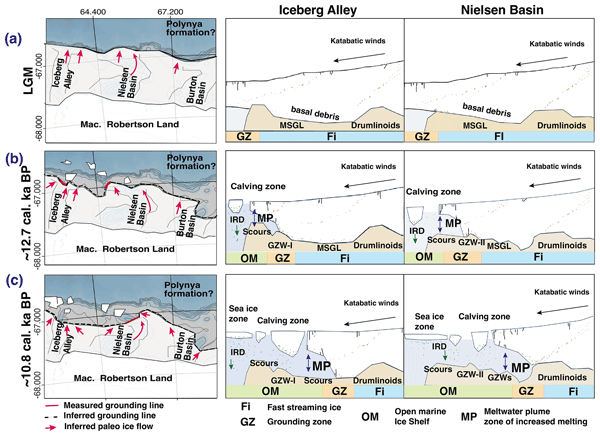
Abstract. The future behavior of the Antarctic Ice Sheet is considered to be one of the largest unknowns in global climate projections, with dramatically accelerating ice loss being observed over the past few decades in multiple drainage basins. However, those records only reflect a short moment of limited informative value when considering the length of a full cycle of ice sheet expansion and retreat. East Antarctica’s deglaciation history remains largely understudied compared to the West Antarctic margin. This emphasizes the urgent need for reliable long-term spatiotemporal data on ice sheet change, particularly for sectors that play key roles in supplying the world’s oceans with dense bottom water. In this study, we performed a multi-proxy analysis on a set of sediment cores recovered from two prominent glacial cross-shelf troughs on the Mac. Robertson Shelf. We classified submarine glacial landforms on the shelf along both troughs from combined multibeam swath bathymetry and sub-bottom profiler data to infer ice sheet retreat dynamics. Additionally, combined sedimentological, sediment-physical, and geochemical analyses, including radiocarbon ages of foraminifera, reveal the onset of deglaciation on the Mac. Robertson Shelf and the subsequent retreat of the grounding line (GL). Glacial bedforms indicate an episodic retreat of the ice sheet’s GL, which started with a slow retreat on the outer shelf and accelerated towards the retrograde mid-shelf part. Across the mid-shelf, the GL repeatedly halted, leading to the formation of several small grounding-zone wedges. A mid-shelf bedrock sill likely acted as a pinning point, indicating an additional grounding line stabilization period. Our study reveals that the grounding line advanced to the continental shelf break prior to ~12.5 cal. ka BP, which prevented the formation of dense shelf water on the Mac. Robertson Shelf in its current form and, therefore, suggests either an absent or a different formation mechanism of Antarctic Bottom Water under full glacial conditions. Further, we conclude a retreat at or shortly after the Antarctic Cold Reversal ~12,5 calibrated kiloyears before the present (i.e., 1950 CE, cal. ka BP) from the outer shelf.
-
Notice on discussion status
The requested preprint has a corresponding peer-reviewed final revised paper. You are encouraged to refer to the final revised version.
-
Preprint
(7796 KB)
-
Supplement
(3929 KB)
-
The requested preprint has a corresponding peer-reviewed final revised paper. You are encouraged to refer to the final revised version.
- Preprint
(7796 KB) - Metadata XML
-
Supplement
(3929 KB) - BibTeX
- EndNote
- Final revised paper


Journal article(s) based on this preprint
Interactive discussion
Status: closed
-
RC1: 'Comment on egusphere-2025-2515', Sarah Greenwood, 04 Sep 2025
- AC2: 'Reply on RC1', Janina Güntzel, 02 Mar 2026
-
RC2: 'Comment on egusphere-2025-2515', Ola Fredin, 02 Feb 2026
The manuscript presents important new constraints on the deglaciation history of the Mac. Robertson Shelf (East Antarctica), through high‑resolution geomorphological mapping and new radiocarbon dating indicating that the grounding line likely remained near the shelf edge until in very late glacial time (12.5 ka BP). The integration of sedimentological proxies with detailed bathymetry is a major strength and provides a case for extensive glaciation during the Last Glacial Maximum. However, the chronology contains uncertainties, particularly regarding the interpretation of AIO versus foraminiferal ages and the potential reworking of older specimens, that should be more thoroughly addressed. Strengthening the discussion of plausible oceanographic mechanisms capable of delivering modified Circumpolar Deep Water across a dense‑shelf regime would also further reinforce the study’s conclusions.
See the attached document for detailed comments and suggestions for improvement.
-
AC1: 'Reply on RC2', Janina Güntzel, 02 Mar 2026
Dear Ola Fredin,
We appreciate the time and expertise invested in reviewing our manuscript.
We thank you for the valuable feedback and for the opportunity to strengthen our study.
We have carefully considered the comments and addressed them in the attached PDF.
-
AC1: 'Reply on RC2', Janina Güntzel, 02 Mar 2026
Peer review completion


Interactive discussion
Status: closed
-
RC1: 'Comment on egusphere-2025-2515', Sarah Greenwood, 04 Sep 2025
This manuscript presents valuable new data, arrives at potentially important conclusions regarding the timing of deglaciation of a very poorly known sector of the Antarctic continental shelf, and has important implications for deep water formation during the last glacial and deglacial periods. However, the manuscript structure, language, discussion and presentation need some attention before publication. Some method details are unclear or missing, as is some information that ought to be presented on figures.
Please see the attached pdf for full review.
- AC2: 'Reply on RC1', Janina Güntzel, 02 Mar 2026
-
RC2: 'Comment on egusphere-2025-2515', Ola Fredin, 02 Feb 2026
The manuscript presents important new constraints on the deglaciation history of the Mac. Robertson Shelf (East Antarctica), through high‑resolution geomorphological mapping and new radiocarbon dating indicating that the grounding line likely remained near the shelf edge until in very late glacial time (12.5 ka BP). The integration of sedimentological proxies with detailed bathymetry is a major strength and provides a case for extensive glaciation during the Last Glacial Maximum. However, the chronology contains uncertainties, particularly regarding the interpretation of AIO versus foraminiferal ages and the potential reworking of older specimens, that should be more thoroughly addressed. Strengthening the discussion of plausible oceanographic mechanisms capable of delivering modified Circumpolar Deep Water across a dense‑shelf regime would also further reinforce the study’s conclusions.
See the attached document for detailed comments and suggestions for improvement.
-
AC1: 'Reply on RC2', Janina Güntzel, 02 Mar 2026
Dear Ola Fredin,
We appreciate the time and expertise invested in reviewing our manuscript.
We thank you for the valuable feedback and for the opportunity to strengthen our study.
We have carefully considered the comments and addressed them in the attached PDF.
-
AC1: 'Reply on RC2', Janina Güntzel, 02 Mar 2026
Peer review completion
Journal article(s) based on this preprint
Viewed
| HTML | XML | Total | Supplement | BibTeX | EndNote | |
|---|---|---|---|---|---|---|
| 11,342 | 1,632 | 253 | 13,227 | 392 | 332 | 360 |
- HTML: 11,342
- PDF: 1,632
- XML: 253
- Total: 13,227
- Supplement: 392
- BibTeX: 332
- EndNote: 360
Viewed (geographical distribution)
| Country | # | Views | % |
|---|
| Total: | 0 |
| HTML: | 0 |
| PDF: | 0 |
| XML: | 0 |
- 1

Juliane Müller
Ralf Tiedemann
Gesine Mollenhauer
Lester Lembke-Jene
Estella Weigelt
Lasse Schopen
Niklas Wesch
Laura Kattein
Andrew N. Mackintosh
Johann P. Klages
The requested preprint has a corresponding peer-reviewed final revised paper. You are encouraged to refer to the final revised version.
- Preprint
(7796 KB) - Metadata XML
-
Supplement
(3929 KB) - BibTeX
- EndNote
- Final revised paper
This manuscript presents valuable new data, arrives at potentially important conclusions regarding the timing of deglaciation of a very poorly known sector of the Antarctic continental shelf, and has important implications for deep water formation during the last glacial and deglacial periods. However, the manuscript structure, language, discussion and presentation need some attention before publication. Some method details are unclear or missing, as is some information that ought to be presented on figures.
Please see the attached pdf for full review.