
the Creative Commons Attribution 4.0 License.
the Creative Commons Attribution 4.0 License.
 | 30 May 2025
Limited effect of organic matter addition on stabilised organic carbon in four tropical arable soils
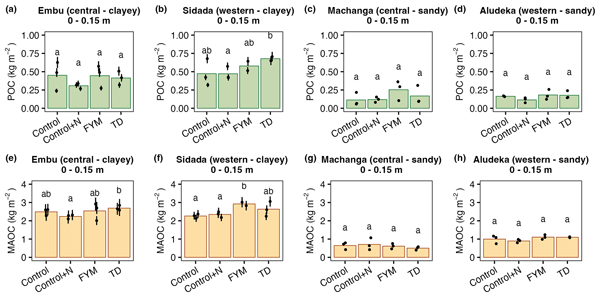
Abstract. Arable soils are generally characterised by a low soil organic carbon (SOC) content, with negative consequences for soil health, crop yield and global climate. Thus, over the past decades, there has been a focus on how agricultural management practices, such as organic resource addition, can increase the amount of SOC. To sustainably increase SOC stocks, a portion of the organic amendments added to the soil has to be stabilised in persistent fractions such as mineral-associated organic carbon (MAOC). However, there is a lack of research on the magnitude of changes in MAOC in tropical agroecosystems in response to organic resource additions. Here, we show for four long-term field trials in Kenya that the addition of large amounts of organic amendments (farmyard manure or Tithonia diversifolia biomass at 4 t C ha-1 yr-1 for 16 to 19 years) to maize monocropping systems had variable effects on topsoil MAOC stocks (0–15 cm depth), and no significant effect on subsoil MAOC stocks (15–50 cm depth) compared to a control treatment. The addition of mineral N fertiliser did not affect MAOC stocks at any site. Using stable carbon isotopes δ13C, we found that the portion of topsoil MAOC originating from Tithonia biomass was larger in the sandy (25–40 %) compared to the clayey soils (0.5–12 %), while the portion of total added Tithonia biomass that was stabilised over a time period of 16–19 years was below 7 % across all sites, or a SOC stabilisation rate of 0.8–27 g C m-2 yr-1. Using these results, we conclude that while in sandy soils the stabilisation of added OC contributed substantially to limiting SOC losses upon cultivation, this was not the case for clayey soils. These differences were due to the much lower SOC stocks in the sandy soils, compared to the clayey soils. Our results underline the challenges associated with improving soil health in sub-Saharan Africa and stress the need for more research to reliably assess if and how additional SOC can be stabilised over decadal time scales in highly weathered tropical soils.
Competing interests: At least one of the (co-)authors is a member of the editorial board of SOIL. The peer-review process was guided by an independent editor, and the authors also have no other competing interests to declare.
Publisher's note: Copernicus Publications remains neutral with regard to jurisdictional claims made in the text, published maps, institutional affiliations, or any other geographical representation in this paper. While Copernicus Publications makes every effort to include appropriate place names, the final responsibility lies with the authors. Views expressed in the text are those of the authors and do not necessarily reflect the views of the publisher.-
Notice on discussion status
The requested preprint has a corresponding peer-reviewed final revised paper. You are encouraged to refer to the final revised version.
-
Preprint
(1567 KB)
-
Supplement
(14885 KB)
-
The requested preprint has a corresponding peer-reviewed final revised paper. You are encouraged to refer to the final revised version.
- Preprint
(1567 KB) - Metadata XML
-
Supplement
(14885 KB) - BibTeX
- EndNote
- Final revised paper


Journal article(s) based on this preprint
Interactive discussion
Status: closed
-
RC1: 'Comment on egusphere-2025-2287', Anonymous Referee #1, 01 Sep 2025
-
AC1: 'Reply on RC1', Marijn Van de Broek, 05 Dec 2025
The comment was uploaded in the form of a supplement: https://egusphere.copernicus.org/preprints/2025/egusphere-2025-2287/egusphere-2025-2287-AC1-supplement.pdf
-
AC1: 'Reply on RC1', Marijn Van de Broek, 05 Dec 2025
-
RC2: 'Comment on egusphere-2025-2287', Anonymous Referee #2, 16 Nov 2025
The study described by Van de Broek et al capitalizes on a long term ISFM field experiment in central Kenya (Embu and Machanga) and western Kenya (Sidada and Aludeka) Kenya. The study builds on extensive SOC research performed at the same sites and published in multiple papers by Mortiz Laub et al.
This study adds information to the previous work by measuring MAOM and POM fractions. d13C and D 14C radioisotopes on a selection of the ISFM treatments.
This study is a valuable addition to the previous publications as it gained new insights on the fractions of MAOC and POC and the stabilisation of amended carbon in MAOC.
Variable topsoil MAOC stocks in the topsoil as an effect of nutrient or organic amendment application (Tithonia diversifolia or Farm Yard manure addition)
Clear differences in MAOC stocks between in clayey and sandy sites.
No significant differences in SOC fractions in the subsoil (15-50cm0.
Previous studies (Laub et al 2023) showed that organic amendments reduced native SOC losses from these field sites. This study showed that the prevented losses in the clayey sites were not caused by the formation of newly formed MAOC from added organic amendments but originated from prevented losses of native SOC while in the sandy soils the lower losses were partly caused by new MAOC stabilisation.
More specific comments on the manuscript:
Line 11: Given the distinct stable carbon isotopes signatures of C3 and C4 substrates of Maiz and Tithonia we calculated.. etc.
Line 96 You now name the treatments nutrient management strategies. However before you this term was not used and only organic amendments and mineral fertilizer addition was used to indicate the different treatments. I would replace “nutrient management strategies” with “amendments”.
Line 98 why a question on the15-50cm layer and measurements in two layers 15-30, 30-50 cm? See also line 134.
Why then use alle layers in figure 1 and in text for instance Line 324.
Line 117: For the reader it is difficult to assess what the influence is of the intense topsoil erosion throughout the experiment at the Machanga site. As the site is included in all the analysis the erosion is not strong enough to exclude this site from this study? No bias expected. This could be explained a bit more.
Table 1Could the SOC stocks from Laub et al 2023 be added to this table to make a clear distinction between what is new and what is already published in previous papers?
Why was the HCL, NaOH procedure used for the D 14C radioisotopes while this was skipped for the OC procedures (Line 203-205)
Line 2014-2015. Not very clearly explained here. What is meant with equivalent soil masses of the respective soil layer, no bulk density of the layers used, Why not? What is meant with a common depth.
Line 223: Can at least a range of d13C be mentioned for the Farm yard manure?
Line 367 not correct see also other reviewer
Line 388 not OC stocks but SOC stock?
Line 398: would you expect to find differences with higher numbers of replications? Be more explicit here and a bit less
Line 402: Which are in the lower range. 0,2%-4.9% is a lot lower than the average 8,2%!
There is a pressing need for more studies closing the knowledge gap on Soc stabilisation in tropical ecosystems. However, more long-term field trials are needed in tropical ecosystems also in other regions and countries to get representative data.
Citation: https://doi.org/10.5194/egusphere-2025-2287-RC2 -
AC2: 'Reply on RC2', Marijn Van de Broek, 05 Dec 2025
The comment was uploaded in the form of a supplement: https://egusphere.copernicus.org/preprints/2025/egusphere-2025-2287/egusphere-2025-2287-AC2-supplement.pdf
-
AC2: 'Reply on RC2', Marijn Van de Broek, 05 Dec 2025


Interactive discussion
Status: closed
-
RC1: 'Comment on egusphere-2025-2287', Anonymous Referee #1, 01 Sep 2025
This paper presents a very interesting experiment set in Kenya to explore the impact of agricultural nutrient management on stabilized SOC in a robust experimental design. The introduction strongly stresses the lack of studies on the effects of agricultural management practices on SOC stocks in sub-Saharan Africa.
The experiment consists in 4 sites of maize monocropping (1 clayey in central Kenya, 1 sandy in central Kenya, 1 clayey in western Kenya and 1 sandy in western Kenya), with 4 treatments per site (control, control+N, Tithonia diversifolia amendment and farmyard manure amendment), 3 replicates per treatment in each site, and 3 sampling depths, leading to a total of 144 samples. The authors studied SOC, N, δ13C, and Δ14C, and used a size- and density-fractionation protocol to separate the POM and MAOM fractions.
The main result is that, unfortunately, long-term, continuous application of OM does not seem to lead to an increase in SOC stocks, neither in topsoil nor subsoil, although it helps slowing down the SOC loss. While the findings themselves form a new and important piece of knowledge, they also highlight the potentially large gap between the results obtained in temperate zones and the field reality in sub-Saharan Africa, stressing the need for more regional studies in the tropical lands. Overall, a very nice and interesting paper!
Here are some thoughts:
- A summary illustration of the experiment (visually combining Table 1 and Figure S1, and showing the 4 treatments/3 replicates) could be useful. That being said, the experiment is well-described.
- L180: out of curiosity, do you see an explanation for the different values of SPT needed for good separation?
- L189: how did you make sure to retrieve all your MAOM during the rinsing of the floculant, since you added floculant because you couldn’t retrieve all the flotting MAOM?
- L196: how was the subsampling done, by hand or with an automatic subsampler?
- L197: any other plausible pathway for loss?
- L257: would you say the C:N data (fig.S9) support the idea of ‘MAOM-contaminated’ POM in sandy soils?
- L304: you specified the site of Machanga was subjected to strong erosion; is the erosion homogeneous on the whole site (all treatments equally affected)? Did you quantify it?
- L331: if I get it right, the portion of TD-derived MAOC can be quite high. However, you stated above that the MAOC stocks weren’t much affected by the treatments. Would this mean that the turnover time of this fraction is (at least for part of it) rather short? It is interesting that these portions of “younger” MAOC are higher in the sites with quite high MAOC Δ14C ages.
- L367: wasn’t your 3rd hypothesis: ‘continuous organic matter addition at the soil surface has no long-term effect on MAOC accumulation in soil layers below 15 cm depth’? I don’t see how it is rejected.
Citation: https://doi.org/10.5194/egusphere-2025-2287-RC1 -
AC1: 'Reply on RC1', Marijn Van de Broek, 05 Dec 2025
The comment was uploaded in the form of a supplement: https://egusphere.copernicus.org/preprints/2025/egusphere-2025-2287/egusphere-2025-2287-AC1-supplement.pdf
-
RC2: 'Comment on egusphere-2025-2287', Anonymous Referee #2, 16 Nov 2025
The study described by Van de Broek et al capitalizes on a long term ISFM field experiment in central Kenya (Embu and Machanga) and western Kenya (Sidada and Aludeka) Kenya. The study builds on extensive SOC research performed at the same sites and published in multiple papers by Mortiz Laub et al.
This study adds information to the previous work by measuring MAOM and POM fractions. d13C and D 14C radioisotopes on a selection of the ISFM treatments.
This study is a valuable addition to the previous publications as it gained new insights on the fractions of MAOC and POC and the stabilisation of amended carbon in MAOC.
Variable topsoil MAOC stocks in the topsoil as an effect of nutrient or organic amendment application (Tithonia diversifolia or Farm Yard manure addition)
Clear differences in MAOC stocks between in clayey and sandy sites.
No significant differences in SOC fractions in the subsoil (15-50cm0.
Previous studies (Laub et al 2023) showed that organic amendments reduced native SOC losses from these field sites. This study showed that the prevented losses in the clayey sites were not caused by the formation of newly formed MAOC from added organic amendments but originated from prevented losses of native SOC while in the sandy soils the lower losses were partly caused by new MAOC stabilisation.
More specific comments on the manuscript:
Line 11: Given the distinct stable carbon isotopes signatures of C3 and C4 substrates of Maiz and Tithonia we calculated.. etc.
Line 96 You now name the treatments nutrient management strategies. However before you this term was not used and only organic amendments and mineral fertilizer addition was used to indicate the different treatments. I would replace “nutrient management strategies” with “amendments”.
Line 98 why a question on the15-50cm layer and measurements in two layers 15-30, 30-50 cm? See also line 134.
Why then use alle layers in figure 1 and in text for instance Line 324.
Line 117: For the reader it is difficult to assess what the influence is of the intense topsoil erosion throughout the experiment at the Machanga site. As the site is included in all the analysis the erosion is not strong enough to exclude this site from this study? No bias expected. This could be explained a bit more.
Table 1Could the SOC stocks from Laub et al 2023 be added to this table to make a clear distinction between what is new and what is already published in previous papers?
Why was the HCL, NaOH procedure used for the D 14C radioisotopes while this was skipped for the OC procedures (Line 203-205)
Line 2014-2015. Not very clearly explained here. What is meant with equivalent soil masses of the respective soil layer, no bulk density of the layers used, Why not? What is meant with a common depth.
Line 223: Can at least a range of d13C be mentioned for the Farm yard manure?
Line 367 not correct see also other reviewer
Line 388 not OC stocks but SOC stock?
Line 398: would you expect to find differences with higher numbers of replications? Be more explicit here and a bit less
Line 402: Which are in the lower range. 0,2%-4.9% is a lot lower than the average 8,2%!
There is a pressing need for more studies closing the knowledge gap on Soc stabilisation in tropical ecosystems. However, more long-term field trials are needed in tropical ecosystems also in other regions and countries to get representative data.
Citation: https://doi.org/10.5194/egusphere-2025-2287-RC2 -
AC2: 'Reply on RC2', Marijn Van de Broek, 05 Dec 2025
The comment was uploaded in the form of a supplement: https://egusphere.copernicus.org/preprints/2025/egusphere-2025-2287/egusphere-2025-2287-AC2-supplement.pdf
-
AC2: 'Reply on RC2', Marijn Van de Broek, 05 Dec 2025
Peer review completion


Journal article(s) based on this preprint
Viewed
| HTML | XML | Total | Supplement | BibTeX | EndNote | |
|---|---|---|---|---|---|---|
| 980 | 246 | 33 | 1,259 | 127 | 30 | 48 |
- HTML: 980
- PDF: 246
- XML: 33
- Total: 1,259
- Supplement: 127
- BibTeX: 30
- EndNote: 48
Viewed (geographical distribution)
| Country | # | Views | % |
|---|
| Total: | 0 |
| HTML: | 0 |
| PDF: | 0 |
| XML: | 0 |
- 1
Marijn Van de Broek
Fiona Stewart-Smith
Moritz Laub
Marc Corbeels
Monicah Wanjiku Mucheru-Muna
Daniel Mugendi
Wycliffe Waswa
Bernard Vanlauwe
Johan Six
The requested preprint has a corresponding peer-reviewed final revised paper. You are encouraged to refer to the final revised version.
- Preprint
(1567 KB) - Metadata XML
-
Supplement
(14885 KB) - BibTeX
- EndNote
- Final revised paper
This paper presents a very interesting experiment set in Kenya to explore the impact of agricultural nutrient management on stabilized SOC in a robust experimental design. The introduction strongly stresses the lack of studies on the effects of agricultural management practices on SOC stocks in sub-Saharan Africa.
The experiment consists in 4 sites of maize monocropping (1 clayey in central Kenya, 1 sandy in central Kenya, 1 clayey in western Kenya and 1 sandy in western Kenya), with 4 treatments per site (control, control+N, Tithonia diversifolia amendment and farmyard manure amendment), 3 replicates per treatment in each site, and 3 sampling depths, leading to a total of 144 samples. The authors studied SOC, N, δ13C, and Δ14C, and used a size- and density-fractionation protocol to separate the POM and MAOM fractions.
The main result is that, unfortunately, long-term, continuous application of OM does not seem to lead to an increase in SOC stocks, neither in topsoil nor subsoil, although it helps slowing down the SOC loss. While the findings themselves form a new and important piece of knowledge, they also highlight the potentially large gap between the results obtained in temperate zones and the field reality in sub-Saharan Africa, stressing the need for more regional studies in the tropical lands. Overall, a very nice and interesting paper!
Here are some thoughts: