
the Creative Commons Attribution 4.0 License.
the Creative Commons Attribution 4.0 License.
 | 24 Jun 2025
Changing drivers of regional large magnitude avalanche frequency throughout Colorado, USA
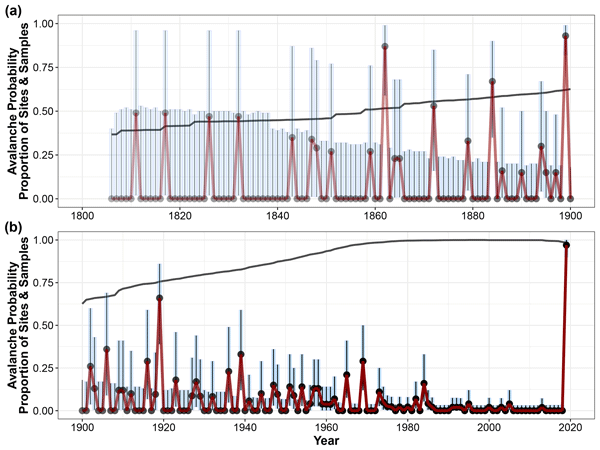
Abstract. Large magnitude snow avalanches (size ≥D3) impact settlements, transportation corridors, and public safety worldwide. In Colorado, United States, avalanches have killed more people than any other natural hazard since 1950. In March 2019, a large magnitude avalanche cycle occurred throughout the entire mountainous portion of Colorado resulting in more than 1,000 reported avalanches during a two-week period. Nearly 200 of these avalanches were size D4 or larger with at least three D5 avalanches. However, placing this 2019 large magnitude avalanche cycle in historic context requires data prior to the instrumental record. Here, we paired tree disturbance data from dendrochronology (1698 to 2020) with meteorological data from the modeled and instrumental record (1901 to 2020) to understand the frequency and climate drivers of large magnitude snow avalanche cycles. The extensive number of downed trees from the 2019 avalanche cycle allowed us to collect 1,188 cross-sections and cores from 1,023 individual trees within 24 avalanche paths across the state. From these samples we identified 4,135 avalanche-related growth disturbances. We employed a strategic nested sampling design to spatially aggregate avalanche frequency from individual avalanche paths, to counties, to three major sub-regions (i.e., north, central, and south), and across the entire region (i.e., state of Colorado). Over a period spanning more than three centuries (1698 to 2020), we identified 76 avalanche years within 24 individual avalanche paths. Large magnitude avalanche event frequency varied across paths and sub-regions with several notable region-wide avalanche cycles. Both tree-ring and historical written records highlighted 1899 as a year with widespread and large magnitude avalanche activity similar to the March 2019 avalanche cycle. Since the early-20th century (1900 to 2020) regional avalanche probability declined significantly in parallel with decreasing snowpack throughout Colorado. Similarly, dominant avalanche regimes shifted from large magnitude regional cycles driven by above average snowfall years over most of the record, to regional avalanche cycles occurring more commonly in average to low snow years since 1988. In recent decades, a lack of December precipitation and above average March precipitation characterized years with regional large magnitude avalanche activity. Understanding the changing snow and weather drivers and subsequent behavior of large magnitude avalanche cycles across multiple spatial scales may improve avalanche forecasting and the products and mitigations strategies developed by structural engineers to mitigate avalanche danger. This can decrease the avalanche risk to the public and improve infrastructure design in avalanche terrain.
Competing interests: At least one of the (co-)authors is a member of the editorial board of Natural Hazards and Earth System Sciences.
Publisher's note: Copernicus Publications remains neutral with regard to jurisdictional claims made in the text, published maps, institutional affiliations, or any other geographical representation in this paper. While Copernicus Publications makes every effort to include appropriate place names, the final responsibility lies with the authors. Views expressed in the text are those of the authors and do not necessarily reflect the views of the publisher.-
Notice on discussion status
The requested preprint has a corresponding peer-reviewed final revised paper. You are encouraged to refer to the final revised version.
-
Preprint
(5765 KB)
-
Supplement
(1492 KB)
-
The requested preprint has a corresponding peer-reviewed final revised paper. You are encouraged to refer to the final revised version.
- Preprint
(5765 KB) - Metadata XML
-
Supplement
(1492 KB) - BibTeX
- EndNote
- Final revised paper


Journal article(s) based on this preprint
Interactive discussion
Status: closed
-
RC1: 'Comment on egusphere-2025-2217', Frank Techel, 09 Sep 2025
-
AC2: 'Reply on RC1', Erich Peitzsch, 30 Jan 2026
Thank you, Dr. Techel, for your time and review of our manuscript. We are pleased that you find this work highly relevant and an important contribution. Please find our responses to each of your comments below.
Abstract and Conclusion
- I suggest emphasizing more strongly a key applied takeaway: despite declining SWE values and a lower frequency of RLMA, truly extreme RLMA years remain possible, as the 2019 cycle has shown. This message has high practical relevance for forecasting, mitigation, and infrastructure planning – and likely also for policy makers.
Response: We will emphasize this more heavily in both the Abstract and Conclusion sections in the revised manuscript.
- Abstract L14: When introducing size ≥ D3, consider clarifying this as “(destructive size ≥ D3).”
Response: We will add ‘destructive’ to the revised manuscript.
Data
- The number of trees sampled (1,023 trees, 1,188 samples) currently appears in Section 3.1 under Results. It may be clearer to introduce this earlier, for example as Section 2.2 under a Data heading. Sections 2.2–2.5 could then form the Methods. This restructuring would improve the logical flow.
Response: Good suggestion. We will add this earlier in the manuscript with a new heading in the Methods section.
Methods
- L218–222, L225: An overview figure displaying the three analysis periods (1980–2019, 1900–2019, 1806–2019), and how each is used, would help orient the reader. Since the 1900–2019 period is further subdivided, this could possibly also be indicated within the same figure.
- The methods section is very dense. A flowchart or schematic illustrating the workflow - showing how analyses were conducted and how each step informed the next - would improve accessibility. This could even be combined with the overview figure suggested above.
Response to both points: Another good suggestion. We will add an overview schematic of our workflow and how that pertains to each period. We agree that this will help with readability.
Results and Figures
- The Results section is very rich in findings, with far more described in the text than shown in Figures 3–7. Many additional results are in the Supplement, which is fine, but the density of the main section makes it challenging to follow.
Response: We will take this into consideration and find ways to make the Results section a bit more concise in the revised manuscript.
- Section 3.1: The mean age of sampled trees is 127 years. Could this partly reflect the legacy of the 1899 extreme avalanche year, which may have removed older trees, like the effect of 2019?
Response: Yes, there are several factors that could impact the mean age of sampled trees: the 1899 cycle, deforestation, and wildfires among others. We will mention this in the Discussion. Given that we were able to sample trees older than this throughout the study domain coupled with our hierarchical Bayesian modelling approach, we are confident that the tree-ring record adequately represents a regional record of large magnitude cycles.
- Figure 2: Consider adding a timeline showing the proportion of trees alive in each year. This would clearly illustrate why uncertainty grows further back in time. While Figure 2b and Figure 3 partly address this, a dedicated visualization would be clearer.
Response: We can certainly add a panel that explicitly shows this in Figure 2 and enhances the decline in uncertainty back in time in Figure 3.
- Table 1: Consider moving this detailed table to the Appendix and keeping a more concise summary (table or figure) in the main text.
Response: We will make this into a more concise table in the revised manuscript.
- Figure 3: A central figure, but visually complex. Colors are difficult to distinguish, simplifying or improving contrast would help.
Response: We will improve contrast in Figure 3 in the revised figure.
- Figures 4 and 5: Clarify more clearly which colors represent RLMA years vs. non-RLMA years in a legend.
Response: We will add a legend representing RLMA and non-RLMA years.
- Figure 5: The order of panels (December, March, November, winter) is not intuitive, reordering to a chronological sequence would improve readability.
Response: We will revise Figure 5 to a chronological order.
Citation: https://doi.org/10.5194/egusphere-2025-2217-AC2
-
AC2: 'Reply on RC1', Erich Peitzsch, 30 Jan 2026
-
RC2: 'Comment on egusphere-2025-2217', Zachary Miller, 30 Jan 2026
This paper discusses the drivers of regional large-magnitude avalanche events in Colorado, USA. The authors use up-to-date dendrochronology and snow modeling methods to reconstruct historic avalanche chronologies, then analyze those time series through the lens of climatological non-stationarity to identify the temporal patterns and meteorological influences of these destructive natural occurrences. The methods leveraged and results of this work are relevant directly to the NHESS community of researchers, field-based practitioners, and local government planners. Although this paper reports similar findings to other recently published work from different mountain regions, it arrives at those results by analyzing a large novel dataset using new methodologies for trend identification. The conclusions drawn by the authors are well supported by both their work and the body of literature growing around this subject. In addition, this paper is a valuable contribution to natural hazard research fields of mountain snow, large avalanches, and their interactions with climate.
I recommend this paper for publication after a few small line-specific (listed below) comments are addressed.
Line-specific comments:
- 45: “CAIC” needs capitalization
- 69: Citation list is alphabetical despite all others being chronological
- 306: Was there an attempt to sample any avalanche paths within the region that were not affected by the 2019 cycle but are suspected to have been affected by previous RLMA events?
- Figure S2: Winter “SWE” needs to be capitalized in the plot
Citation: https://doi.org/10.5194/egusphere-2025-2217-RC2 -
AC1: 'Reply on RC2', Erich Peitzsch, 30 Jan 2026
Thank you, Mr. Miller, for your time and review of our manuscript. We are pleased that you find this work valuable and with the overall positive review. Please find our responses to each of your comments below.
Line-specific comments:
45: “CAIC” needs capitalization
Response: We will correct this in the revised version of the manuscript.
69: Citation list is alphabetical despite all others being chronological
Response: We will correct this in the revised version of the manuscript.
306: Was there an attempt to sample any avalanche paths within the region that were not affected by the 2019 cycle but are suspected to have been affected by previous RLMA events?
Response: Good question. We ultimately decided to sample paths with clear evidence of large magnitude avalanches in 2019 for two reasons. First, the 2019 cycle provided ample material (i.e. dead and downed trees) from which to sample allowing us to collect such a large dataset. Avalanche paths without dead and downed trees lacked material from which we could sample. Second, given the widespread nature of this avalanche cycle, we deemed any avalanche path without clear evidence of avalanche impact either unrepresentative or potentially unreliable.
Figure S2: Winter “SWE” needs to be capitalized in the plot
Response: We will correct this in the revised version of the manuscript.
Citation: https://doi.org/10.5194/egusphere-2025-2217-AC1


Interactive discussion
Status: closed
-
RC1: 'Comment on egusphere-2025-2217', Frank Techel, 09 Sep 2025
This study reconstructs the frequency and climatic drivers of regional large-magnitude avalanches (RLMA) in Colorado over more than two centuries, using dendrochronological data collected after the 2019 avalanche cycle together with modern climate datasets and hierarchical Bayesian modelling. The analysis provides robust evidence for a long-term decline in RLMA activity since the early 20th century, alongside a shift in climatic drivers. The dataset is exceptional, the methods are rigorous, and the findings are highly relevant for both avalanche science and applied contexts such as forecasting and infrastructure planning.
I view this paper as an important contribution that merits publication. My comments focus mainly on accessibility - since the manuscript is dense and technical - rather than on substantive scientific concerns. The main text is tightly packed, and many additional figures are presented only in the Supplement.
Abstract and Conclusion
- I suggest emphasizing more strongly a key applied takeaway: despite declining SWE values and a lower frequency of RLMA, truly extreme RLMA years remain possible, as the 2019 cycle has shown. This message has high practical relevance for forecasting, mitigation, and infrastructure planning – and likely also for policy makers.
- Abstract L14: When introducing size ≥ D3, consider clarifying this as “(destructive size ≥ D3).”
Data
- The number of trees sampled (1,023 trees, 1,188 samples) currently appears in Section 3.1 under Results. It may be clearer to introduce this earlier, for example as Section 2.2 under a Data heading. Sections 2.2–2.5 could then form the Methods. This restructuring would improve the logical flow.
Methods
- L218–222, L225: An overview figure displaying the three analysis periods (1980–2019, 1900–2019, 1806–2019), and how each is used, would help orient the reader. Since the 1900–2019 period is further subdivided, this could possibly also be indicated within the same figure.
- The methods section is very dense. A flowchart or schematic illustrating the workflow - showing how analyses were conducted and how each step informed the next - would improve accessibility. This could even be combined with the overview figure suggested above.
Results and Figures
- The Results section is very rich in findings, with far more described in the text than shown in Figures 3–7. Many additional results are in the Supplement, which is fine, but the density of the main section makes it challenging to follow.
- Section 3.1: The mean age of sampled trees is 127 years. Could this partly reflect the legacy of the 1899 extreme avalanche year, which may have removed older trees, like the effect of 2019?
- Figure 2: Consider adding a timeline showing the proportion of trees alive in each year. This would clearly illustrate why uncertainty grows further back in time. While Figure 2b and Figure 3 partly address this, a dedicated visualization would be clearer.
- Table 1: Consider moving this detailed table to the Appendix and keeping a more concise summary (table or figure) in the main text.
- Figure 3: A central figure, but visually complex. Colors are difficult to distinguish, simplifying or improving contrast would help.
- Figures 4 and 5: Clarify more clearly which colors represent RLMA years vs. non-RLMA years in a legend.
- Figure 5: The order of panels (December, March, November, winter) is not intuitive, reordering to a chronological sequence would improve readability.
Citation: https://doi.org/10.5194/egusphere-2025-2217-RC1 -
AC2: 'Reply on RC1', Erich Peitzsch, 30 Jan 2026
Thank you, Dr. Techel, for your time and review of our manuscript. We are pleased that you find this work highly relevant and an important contribution. Please find our responses to each of your comments below.
Abstract and Conclusion
- I suggest emphasizing more strongly a key applied takeaway: despite declining SWE values and a lower frequency of RLMA, truly extreme RLMA years remain possible, as the 2019 cycle has shown. This message has high practical relevance for forecasting, mitigation, and infrastructure planning – and likely also for policy makers.
Response: We will emphasize this more heavily in both the Abstract and Conclusion sections in the revised manuscript.
- Abstract L14: When introducing size ≥ D3, consider clarifying this as “(destructive size ≥ D3).”
Response: We will add ‘destructive’ to the revised manuscript.
Data
- The number of trees sampled (1,023 trees, 1,188 samples) currently appears in Section 3.1 under Results. It may be clearer to introduce this earlier, for example as Section 2.2 under a Data heading. Sections 2.2–2.5 could then form the Methods. This restructuring would improve the logical flow.
Response: Good suggestion. We will add this earlier in the manuscript with a new heading in the Methods section.
Methods
- L218–222, L225: An overview figure displaying the three analysis periods (1980–2019, 1900–2019, 1806–2019), and how each is used, would help orient the reader. Since the 1900–2019 period is further subdivided, this could possibly also be indicated within the same figure.
- The methods section is very dense. A flowchart or schematic illustrating the workflow - showing how analyses were conducted and how each step informed the next - would improve accessibility. This could even be combined with the overview figure suggested above.
Response to both points: Another good suggestion. We will add an overview schematic of our workflow and how that pertains to each period. We agree that this will help with readability.
Results and Figures
- The Results section is very rich in findings, with far more described in the text than shown in Figures 3–7. Many additional results are in the Supplement, which is fine, but the density of the main section makes it challenging to follow.
Response: We will take this into consideration and find ways to make the Results section a bit more concise in the revised manuscript.
- Section 3.1: The mean age of sampled trees is 127 years. Could this partly reflect the legacy of the 1899 extreme avalanche year, which may have removed older trees, like the effect of 2019?
Response: Yes, there are several factors that could impact the mean age of sampled trees: the 1899 cycle, deforestation, and wildfires among others. We will mention this in the Discussion. Given that we were able to sample trees older than this throughout the study domain coupled with our hierarchical Bayesian modelling approach, we are confident that the tree-ring record adequately represents a regional record of large magnitude cycles.
- Figure 2: Consider adding a timeline showing the proportion of trees alive in each year. This would clearly illustrate why uncertainty grows further back in time. While Figure 2b and Figure 3 partly address this, a dedicated visualization would be clearer.
Response: We can certainly add a panel that explicitly shows this in Figure 2 and enhances the decline in uncertainty back in time in Figure 3.
- Table 1: Consider moving this detailed table to the Appendix and keeping a more concise summary (table or figure) in the main text.
Response: We will make this into a more concise table in the revised manuscript.
- Figure 3: A central figure, but visually complex. Colors are difficult to distinguish, simplifying or improving contrast would help.
Response: We will improve contrast in Figure 3 in the revised figure.
- Figures 4 and 5: Clarify more clearly which colors represent RLMA years vs. non-RLMA years in a legend.
Response: We will add a legend representing RLMA and non-RLMA years.
- Figure 5: The order of panels (December, March, November, winter) is not intuitive, reordering to a chronological sequence would improve readability.
Response: We will revise Figure 5 to a chronological order.
Citation: https://doi.org/10.5194/egusphere-2025-2217-AC2
-
RC2: 'Comment on egusphere-2025-2217', Zachary Miller, 30 Jan 2026
This paper discusses the drivers of regional large-magnitude avalanche events in Colorado, USA. The authors use up-to-date dendrochronology and snow modeling methods to reconstruct historic avalanche chronologies, then analyze those time series through the lens of climatological non-stationarity to identify the temporal patterns and meteorological influences of these destructive natural occurrences. The methods leveraged and results of this work are relevant directly to the NHESS community of researchers, field-based practitioners, and local government planners. Although this paper reports similar findings to other recently published work from different mountain regions, it arrives at those results by analyzing a large novel dataset using new methodologies for trend identification. The conclusions drawn by the authors are well supported by both their work and the body of literature growing around this subject. In addition, this paper is a valuable contribution to natural hazard research fields of mountain snow, large avalanches, and their interactions with climate.
I recommend this paper for publication after a few small line-specific (listed below) comments are addressed.
Line-specific comments:
- 45: “CAIC” needs capitalization
- 69: Citation list is alphabetical despite all others being chronological
- 306: Was there an attempt to sample any avalanche paths within the region that were not affected by the 2019 cycle but are suspected to have been affected by previous RLMA events?
- Figure S2: Winter “SWE” needs to be capitalized in the plot
Citation: https://doi.org/10.5194/egusphere-2025-2217-RC2 -
AC1: 'Reply on RC2', Erich Peitzsch, 30 Jan 2026
Thank you, Mr. Miller, for your time and review of our manuscript. We are pleased that you find this work valuable and with the overall positive review. Please find our responses to each of your comments below.
Line-specific comments:
45: “CAIC” needs capitalization
Response: We will correct this in the revised version of the manuscript.
69: Citation list is alphabetical despite all others being chronological
Response: We will correct this in the revised version of the manuscript.
306: Was there an attempt to sample any avalanche paths within the region that were not affected by the 2019 cycle but are suspected to have been affected by previous RLMA events?
Response: Good question. We ultimately decided to sample paths with clear evidence of large magnitude avalanches in 2019 for two reasons. First, the 2019 cycle provided ample material (i.e. dead and downed trees) from which to sample allowing us to collect such a large dataset. Avalanche paths without dead and downed trees lacked material from which we could sample. Second, given the widespread nature of this avalanche cycle, we deemed any avalanche path without clear evidence of avalanche impact either unrepresentative or potentially unreliable.
Figure S2: Winter “SWE” needs to be capitalized in the plot
Response: We will correct this in the revised version of the manuscript.
Citation: https://doi.org/10.5194/egusphere-2025-2217-AC1
Peer review completion


Journal article(s) based on this preprint
Viewed
| HTML | XML | Total | Supplement | BibTeX | EndNote | |
|---|---|---|---|---|---|---|
| 917 | 134 | 47 | 1,098 | 80 | 28 | 39 |
- HTML: 917
- PDF: 134
- XML: 47
- Total: 1,098
- Supplement: 80
- BibTeX: 28
- EndNote: 39
Viewed (geographical distribution)
| Country | # | Views | % |
|---|
| Total: | 0 |
| HTML: | 0 |
| PDF: | 0 |
| XML: | 0 |
- 1
Justin T. Martin
Ethan M. Greene
Nicolas Eckert
Adrien Favillier
Jason Konigsberg
Nickolas Kichas
Daniel K. Stahle
Karl W. Birkeland
Kelly Elder
Gregory T. Pederson
The requested preprint has a corresponding peer-reviewed final revised paper. You are encouraged to refer to the final revised version.
- Preprint
(5765 KB) - Metadata XML
-
Supplement
(1492 KB) - BibTeX
- EndNote
- Final revised paper
This study reconstructs the frequency and climatic drivers of regional large-magnitude avalanches (RLMA) in Colorado over more than two centuries, using dendrochronological data collected after the 2019 avalanche cycle together with modern climate datasets and hierarchical Bayesian modelling. The analysis provides robust evidence for a long-term decline in RLMA activity since the early 20th century, alongside a shift in climatic drivers. The dataset is exceptional, the methods are rigorous, and the findings are highly relevant for both avalanche science and applied contexts such as forecasting and infrastructure planning.
I view this paper as an important contribution that merits publication. My comments focus mainly on accessibility - since the manuscript is dense and technical - rather than on substantive scientific concerns. The main text is tightly packed, and many additional figures are presented only in the Supplement.
Abstract and Conclusion
Data
Methods
Results and Figures