
the Creative Commons Attribution 4.0 License.
the Creative Commons Attribution 4.0 License.
 | 11 Aug 2025
Studying anomalous propagation over marine areas using an experimental AIS receiver set-up
Abstract. Automatic Identification System (AIS) is a wireless communication system used by vessels to exchange real-time information with each other and with coastal authorities, enhancing situational awareness and maritime safety. Consequently, safety at sea depends on reliable signal transmission, which can be disrupted by anomalous signal propagation. In particular, tropospheric ducting can extend the AIS antenna horizon, allowing messages to be received over greater distances than under standard conditions. To study the behaviour of the AIS signal under standard and anomalous propagation conditions, 1-year of AIS-observations were collected from two antennae at 7 m and 30 m heights above the mean sea level on the Utö Island in the Baltic Sea. The AIS antennae were co-located with mast-mounted measurements of temperature and humidity. This allows for studying the AIS signal propagation alongside observed refractivity profiles. The AIS over-the-horizon observations occurred 59 % of the time for the 30 m antenna and 34 % of the time for the 7 m antenna, mainly during the spring and summer months. A strong diurnal cycle was observed in the Archipelago Sea, north of Utö, while no diurnal cycle was observed in the open sea region south of Utö. During periods of anomalous signal propagation, the AIS messages were received from farther away, from up to 600 km from Utö and the observed received signal strength decayed slower with distance, indicating reductions in propagation losses due to ducting. The anomalous AIS observations were also found to coincide with the stronger and higher observed ducts.
-
Notice on discussion status
The requested preprint has a corresponding peer-reviewed final revised paper. You are encouraged to refer to the final revised version.
-
Preprint
(5488 KB)
-
The requested preprint has a corresponding peer-reviewed final revised paper. You are encouraged to refer to the final revised version.
- Preprint
(5488 KB) - Metadata XML
- BibTeX
- EndNote
- Final revised paper


Journal article(s) based on this preprint
Interactive discussion
Status: closed
-
RC1: 'Comment on egusphere-2025-1790', Alex Chartier, 11 Aug 2025
- AC1: 'Reply on RC1', Laura Rautiainen, 05 Nov 2025
-
RC2: 'Comment on egusphere-2025-1790', Anonymous Referee #2, 10 Sep 2025
The general idea and concept of that paper is certainly valid observing AIS signals at different heights and compare the occurrence, covered distances and directions to locally measured atmospheric parameters like temperature and humidity.
The location and general setup of the measurements is definitely suitable to investigate tropospheric propagations occuring in the VHF range.The manuscript needs to be revised and refined, e.g., by sorting the content, moving rather supplementary materials from Results to the Appendix, and, in particular, by condensing the Methods and Results sections.
The current version of the paper feels rather lengthy, somewhat overloaded and appears to be rather an extended technical report than a full scientific paper for the subsequent reasons.
The actual discussion appears slim, it's rather a summary and an outlook, where in future such a setup could be used for.
Here it would be good to discuss the findings, e.g. local duct with ducts derived from weather model reanalysis / forecasts, which is likely out of the scope of this publication.
Much of the contents worth to place in the Discussion section are already covered in the Results section, where the pure description there is already quite detailed.
I miss a more extensive discussion and comparison to other publications in terms of duct altitudes, widths, covered ranges, seasonal occurrences etc.The conclusions are short, but not too conclusive except the antenna mounted at higher altitudes covers a larger area for both "normal" and "anomalous" propagations and sea areas tend to have better chances to provide favorable conditions.
The use of some terms like "horizon" or "height" of the duct is not strictly clear and needs careful re-phrasing. For the latter, is this the center height of the duct?
details:
L19 "it communicates" the system doesn't communicate, it is used for communication between...
L20 "VHF signals propagate via LoS propgation" - re-phrase
L21 the separation troposphere and physical objects/surfaces needs re-phrasing..., e.g. tropospheric scattering is very common
L33 when introducing M - refer to explanations in sect. 2.5
L36 What are "opportunistic effects" ?
L38/39 This comment/statement for "VHF" is very general... you're mentioning here completely different processes, with much different occurrences and efficiencies (propagation loss), e.g. Earth-Moon-Earth is certainly for most applications irrelavant, especially for AIS, where a few W EIRP instead of several kW EIRP are required.
Otherwise you could also list here Field-Alligned-Irregularities, auroral backscatter, D- or E-region-iono-scatter, Transequatorial propagation etc etc etc...L45 appears to general to me: I suspect radio sondes also fly over the sea, also airplanes collect measurements, though the flight heights might much above the typical tropospheril duct altitudes
L62 "... behave in uexpected ways" means what?
L71 "amsl" - I'd tend to write out the abbreviation once
L80 "GT" as above L71
L88-95 is this paragraph needed for the paper?
L107 "All the antenna cables were set at the same length of 120m." Do you really mean between the antenna and the receiver?
as an example, a 1/2" coaxial cable would have about 4dB loss, and it's a passive 2dBi antenna...
so the sensitivity of your setup is already limited by the long coaxial cable.Fig1 Caption: add The VHF antennae" >are located/mounted< " at 30m and..."
L125 ORBCOMM global AIS data... I'm not too convinced you really needed that data for the study (Sect. 3.6)
what is the outcome of this comparison -> "what have we learnt" ?
It feels like you wanted to >report< on things you've done, but are not crucial...L143 "assumed 1dB here" - see L107 comment
L160 "at least one signal ... per hour" is that really reliable and sufficient?
L190-191 I can't quite follow. In Fig. 4 I see for the winter: increase of "rec.", basically constant "virtual aid" and reduced "preprocessed"
L193-194 "characteristics of the receiving antenna (e.g. height, sensitivity and power)..." why power???
L197 "...potential shadowing of antennae by other ships..." I'd guess this is negligible, if not a small sailing boat hides directly behind a large ship...?
L207- I'd suppress all the data below 10km (at least!) as the local harbour spoils the statistics and as you're rather after "anomalous" propagation these distances are not useful anyway.
Fig7 and next are made for the entire dataset, not specific months, right? It's not clearly stated...
an additional x-axis in units of km would be helpful, log(distance) is not that easy to interprete for mostFig9 is a good candidate for the appendix
Fig10 would this Fig or the content need a normalizing by the number of vessels available in the area ???
thinking of no. of vessels over the year and over the dayL275 occurrence daytime/nighttime - ok, so why is this? worth to e.g. discuss in the Discussion section
-> chances to form suitable temp. and humidity profiles / sea temp. is much more stable than ground/soil/rock, plus air radiative cooling etc.
so, near the archipelago area has less chancesFig11 another candidate for the appendix ... just the numbers in the text or a small table would be fine
Fig12 the colobar is not too suitable, hard to see distinguish anything between 10^3 and 10^5 - either use a different colorbar, or log scale.
Sect3.6 I'm not too convinced, what has been learnt from the global AIS, this probably needs to be clarified more clearly.
In that light, for the global AIS as it is comprised of spaceborne and terrestrial data - during ducting, I'd bet quite some of the AIs signals are not received by the satellites, but at the same time more terrestrial detections will exist, which compensates?...L305-306 I don't agree with this statement... it's actually contradicted with the following sentence.
Furhtermore I think it's valid to assume the receiver will not only receive messages from local boats, but also long distance vessels sailing along the major routes.
I can't see why this shouldn't be the case in October.Fig15 another candidate for the appendix or to be removed as it's basically a scaled version of Fig14. What do we learn from this Fig? Again, just less observations/coverage.
in the right panel, why are there distances near 0km, when it's about OH grids?L327 "percentile is more sensitive to..." -> percentile of distances is more sensitive to...
L328 true, but this would mean it's a duct in specific directions and areas
L330 "However, it is unclear if the anomalous IAS" Why unclear, what else should it be?
L332 This valid test bears the assumption, that the receiver (Utö) is within the duct, but the duct could just be near and the receiver has a favorable incident angle to the duct. -> coming up later again and should be phrased and discussed
-> corresponding speculation in L351, L400Fig16 somewhat hard to see details, especially in the 3rd panel
Fig17 again, why are there distances near 0km? It's certainly not the type of ducting (over hundreds of km) you're aiming for
I'd also move the 2nd panel to the appendix, if needed.Fig18 where is a reasonable discussion of that Fig? There are just statements here and later on...
the lower antenna will likely have much more obstacles than the higher antenna and therefore can't reach that easily low elevation ductsL364 "... is sensitive to number of ..." -> "... is sensitive to the number of ..."
L381 "These atmospheric duct parameters often include duct height, strength, thickness, and slope."
Yes, can you summarise your results, e.g. in table, preferred heights, thicknes etc. ?L383-384 I'd agree, can you perhaps already specify the contribution of this paper?
L386 "... that defines the signal ..." defines -> describes ???
L390-392 again, it's rather a summary, not a discussion... could you "speculate" why the occurrences are different?
different altitudes, thickness, gradients -> intensity etc...L404 "... the occurrence of ducts underestimated ..." -> "... the occurrence of locally observed ducts underestimated ..."
Sorry to be that blunt, I'm still struggeling to see what has been learnt from the 2 antenna setup...Besides that, topics like the likelihood of ducts, existence of high-pressure systems (contant pressure path), suitable temperature / humidity profiles over various terrain and land/sea should be discussed also in the perspective to other publications.
The signficance and importance of the work and data needs to be stressed in comparison to other publications.
Again, I certaily support publishing the observations, but the manuscript needs to be revised significantly, condensed and strengthening of the Discussion and Conclusions.
Further publications perhaps worth to look up:Salamon, S.J., Hansen, H.J. and Abbott, D. (2015), Modelling radio refractive index in the atmospheric surface layer. Electron. Lett., 51: 1119-1121. https://doi.org/10.1049/el.2015.0195
P. VALTR, P. PECHAČ, TROPOSPHERIC REFRACTION MODELING USING RAY-TRACING AND PARABOLIC EQUATION
https://www.radioeng.cz/fulltexts/2005/05_04_098_104.pdfAo, C. O. (2007), Effect of ducting on radio occultation measurements: An assessment based on high-resolution radiosonde soundings, Radio Sci., 42, RS2008, doi:10.1029/2006RS003485.
Tang et al., Atmospheric Ducts Inversion with Over-the-Horizon Propagation of Automatic Identification System Signals
APSIPA Transactions on Signal and Information Processing, 2024, 13, e11
https://www.nowpublishers.com/article/OpenAccessDownload/SIP-20230078Wolinsky-Mancini et al., 4th URSI AT-RASC, Gran Canaria, 19 – 24 May 2024
https://www.ursi.org/proceedings/procAT24/papers/0337.pdfCitation: https://doi.org/10.5194/egusphere-2025-1790-RC2 - AC2: 'Reply on RC2', Laura Rautiainen, 05 Nov 2025
-
RC3: 'Comment on egusphere-2025-1790', Anonymous Referee #2, 10 Sep 2025
2 more points I missed before:
Fig12 I suggest to either swap the upper and lower panels, or at least to mark the months Sept./Oct., alternatively keep the order and mark "quiet" and "anomalous/enhanced" propagation
another reference:
M. Banafaa and A. H. Muqaibel, "Tropospheric Ducting: A Comprehensive Review and Machine Learning-Based Classification Advancements," in IEEE Access, vol. 13, pp. 22510-22534, 2025, doi: 10.1109/ACCESS.2025.3537160.
Citation: https://doi.org/10.5194/egusphere-2025-1790-RC3 - AC2: 'Reply on RC2', Laura Rautiainen, 05 Nov 2025
-
RC4: 'Comment on egusphere-2025-1790', Anonymous Referee #3, 19 Sep 2025
An interesting manuscript showing ideas and possibilities to monitor atmospheric ducting conditions (near) real time, using relatively low-cost, off-the-shelf hardware.
The manuscript feels a bit long with a lot of details. The authors should consider leaving out some details in following chapters:
- remove/shortening last paragraph of chapter 2.1,
- shorten chapter 2.2, ex details on sensors later removed are not necessary, L106-110
- Remove chapter 2.5 and introduce eq 4 and 5 in introduction, second paragraph.
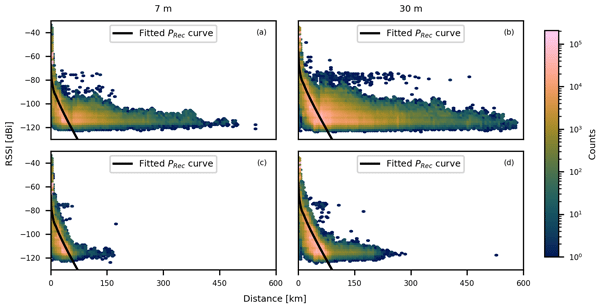
The authors should be consequent when describing the 7 m and 30 m receivers. In some figures 30 is described first, while sometimes the 7 m receiver is described/plotted first. In figs 3, 7, 9, 12, 13, 15 the 7 m receiver is mentioned first, while in figs. 4, 5, 6, 10, 11, 16, 17, 18 the 30 m receiver is described/plotted first. This might be confusing to the reader. Suggestion is to consequently describe/plot 7 m first and 30 m second.
In Discussion line 390-393 comparing your findings with Rautiainen 2025 and Norin 2023 where AIS is more often affected by ducting than X and C band radars: This difference needs a comment or discussion. Usually, higher frequencies (X and C band) are more affected by ducting and require lower/shallower atmospheric ducts than lower frequencies (VHF) to be captured in the duct.
Details, line by line:
53: Consider using Gunashekar et al. 2010, ‘Long-term statistics related to evaporation duct propagation of 2 GHz radio waves in the English Channel’ instead of Gunashekar et al 2006.
75: Clarify that M-profiles are derived from the mast measurements of T, RH.
Fig. 1 a) Arrows pointing at the AIS receivers.
144: Is the maximum estimated AIS range for the 7 m receiver correct? Text says 65-80 km, while in Fig 3 it seems to be approx. 50-75 km. Or do I interpret Fig 3 wrong? I interpret the maximum AIS rang to be where the dashed and dotted green and pink lines cross the black -115 dB line. For 30 m receiver text and Fig 3 are coincidence.
171: Remove the part “the refractivity N”. You have already introduced ‘M’ and said that “For all practical purposes, M is used …” in line 168. The sentence could then be ‘In order to study if ducting influences the AIS range observed in Utö, the modified refractivity M (Eq. 4 and 5) were calculated …..’
Citation: https://doi.org/10.5194/egusphere-2025-1790-RC4 - AC3: 'Reply on RC4', Laura Rautiainen, 05 Nov 2025
Peer review completion


Interactive discussion
Status: closed
-
RC1: 'Comment on egusphere-2025-1790', Alex Chartier, 11 Aug 2025
First review of: Studying anomalous propagation over marine areas using an experimental AIS receiver set-up
Thanks for an interesting manuscript. I have the following comments, but defer to tropospheric experts regarding the significance of the results.
- What is the distribution of propagation distances observed? Can you show a histogram of distances to illustrate the ‘break point’ between normal and anomalous propagation? The selected criterion (95th percentile of maximum distance) seems ad-hoc and vulnerable to variations in the distribution of ships with relation to the receiver station (as noted by the authors between lines 325-30). Why not use a simple distance cutoff (e.g. at least X counts >300 km indicates anomalous propagation)?
- It is not obvious (at least to me) whether the results are in keeping with what is expected from current atmospheric propagation models. Additionally, the ducting analysis is restricted to local conditions at the receiver site (Utö). These two issues could be remedied by comparing the results to duct strengths calculated from meteorological reanalysis data.
- Parts of the introduction seem to make a false dichotomy between VHF and AIS (e.g. 38-40, 52-53). Consider rephrasing.
Line-by-line comments as follows:
14-15: Provide some statistical metric to support the claim that “anomalous AIS observations were also found to coincide with the stronger and higher observed ducts”
41: Specify ‘at distances of less than 1000 km.’
53: Given the separate categorization of (1) AIS and (2) VHF, Chartier et al. (2022) belongs in the first group rather than the second.
223 (and elsewhere): Consider using a different term than ‘horizon’. The manuscript makes sense if ‘horizon’ is interpreted as ‘horizon of observability’, but the most natural interpretation is 'the line at which the earth's surface and the sky appear to meet.’
Citation: https://doi.org/10.5194/egusphere-2025-1790-RC1 - AC1: 'Reply on RC1', Laura Rautiainen, 05 Nov 2025
-
RC2: 'Comment on egusphere-2025-1790', Anonymous Referee #2, 10 Sep 2025
The general idea and concept of that paper is certainly valid observing AIS signals at different heights and compare the occurrence, covered distances and directions to locally measured atmospheric parameters like temperature and humidity.
The location and general setup of the measurements is definitely suitable to investigate tropospheric propagations occuring in the VHF range.The manuscript needs to be revised and refined, e.g., by sorting the content, moving rather supplementary materials from Results to the Appendix, and, in particular, by condensing the Methods and Results sections.
The current version of the paper feels rather lengthy, somewhat overloaded and appears to be rather an extended technical report than a full scientific paper for the subsequent reasons.
The actual discussion appears slim, it's rather a summary and an outlook, where in future such a setup could be used for.
Here it would be good to discuss the findings, e.g. local duct with ducts derived from weather model reanalysis / forecasts, which is likely out of the scope of this publication.
Much of the contents worth to place in the Discussion section are already covered in the Results section, where the pure description there is already quite detailed.
I miss a more extensive discussion and comparison to other publications in terms of duct altitudes, widths, covered ranges, seasonal occurrences etc.The conclusions are short, but not too conclusive except the antenna mounted at higher altitudes covers a larger area for both "normal" and "anomalous" propagations and sea areas tend to have better chances to provide favorable conditions.
The use of some terms like "horizon" or "height" of the duct is not strictly clear and needs careful re-phrasing. For the latter, is this the center height of the duct?
details:
L19 "it communicates" the system doesn't communicate, it is used for communication between...
L20 "VHF signals propagate via LoS propgation" - re-phrase
L21 the separation troposphere and physical objects/surfaces needs re-phrasing..., e.g. tropospheric scattering is very common
L33 when introducing M - refer to explanations in sect. 2.5
L36 What are "opportunistic effects" ?
L38/39 This comment/statement for "VHF" is very general... you're mentioning here completely different processes, with much different occurrences and efficiencies (propagation loss), e.g. Earth-Moon-Earth is certainly for most applications irrelavant, especially for AIS, where a few W EIRP instead of several kW EIRP are required.
Otherwise you could also list here Field-Alligned-Irregularities, auroral backscatter, D- or E-region-iono-scatter, Transequatorial propagation etc etc etc...L45 appears to general to me: I suspect radio sondes also fly over the sea, also airplanes collect measurements, though the flight heights might much above the typical tropospheril duct altitudes
L62 "... behave in uexpected ways" means what?
L71 "amsl" - I'd tend to write out the abbreviation once
L80 "GT" as above L71
L88-95 is this paragraph needed for the paper?
L107 "All the antenna cables were set at the same length of 120m." Do you really mean between the antenna and the receiver?
as an example, a 1/2" coaxial cable would have about 4dB loss, and it's a passive 2dBi antenna...
so the sensitivity of your setup is already limited by the long coaxial cable.Fig1 Caption: add The VHF antennae" >are located/mounted< " at 30m and..."
L125 ORBCOMM global AIS data... I'm not too convinced you really needed that data for the study (Sect. 3.6)
what is the outcome of this comparison -> "what have we learnt" ?
It feels like you wanted to >report< on things you've done, but are not crucial...L143 "assumed 1dB here" - see L107 comment
L160 "at least one signal ... per hour" is that really reliable and sufficient?
L190-191 I can't quite follow. In Fig. 4 I see for the winter: increase of "rec.", basically constant "virtual aid" and reduced "preprocessed"
L193-194 "characteristics of the receiving antenna (e.g. height, sensitivity and power)..." why power???
L197 "...potential shadowing of antennae by other ships..." I'd guess this is negligible, if not a small sailing boat hides directly behind a large ship...?
L207- I'd suppress all the data below 10km (at least!) as the local harbour spoils the statistics and as you're rather after "anomalous" propagation these distances are not useful anyway.
Fig7 and next are made for the entire dataset, not specific months, right? It's not clearly stated...
an additional x-axis in units of km would be helpful, log(distance) is not that easy to interprete for mostFig9 is a good candidate for the appendix
Fig10 would this Fig or the content need a normalizing by the number of vessels available in the area ???
thinking of no. of vessels over the year and over the dayL275 occurrence daytime/nighttime - ok, so why is this? worth to e.g. discuss in the Discussion section
-> chances to form suitable temp. and humidity profiles / sea temp. is much more stable than ground/soil/rock, plus air radiative cooling etc.
so, near the archipelago area has less chancesFig11 another candidate for the appendix ... just the numbers in the text or a small table would be fine
Fig12 the colobar is not too suitable, hard to see distinguish anything between 10^3 and 10^5 - either use a different colorbar, or log scale.
Sect3.6 I'm not too convinced, what has been learnt from the global AIS, this probably needs to be clarified more clearly.
In that light, for the global AIS as it is comprised of spaceborne and terrestrial data - during ducting, I'd bet quite some of the AIs signals are not received by the satellites, but at the same time more terrestrial detections will exist, which compensates?...L305-306 I don't agree with this statement... it's actually contradicted with the following sentence.
Furhtermore I think it's valid to assume the receiver will not only receive messages from local boats, but also long distance vessels sailing along the major routes.
I can't see why this shouldn't be the case in October.Fig15 another candidate for the appendix or to be removed as it's basically a scaled version of Fig14. What do we learn from this Fig? Again, just less observations/coverage.
in the right panel, why are there distances near 0km, when it's about OH grids?L327 "percentile is more sensitive to..." -> percentile of distances is more sensitive to...
L328 true, but this would mean it's a duct in specific directions and areas
L330 "However, it is unclear if the anomalous IAS" Why unclear, what else should it be?
L332 This valid test bears the assumption, that the receiver (Utö) is within the duct, but the duct could just be near and the receiver has a favorable incident angle to the duct. -> coming up later again and should be phrased and discussed
-> corresponding speculation in L351, L400Fig16 somewhat hard to see details, especially in the 3rd panel
Fig17 again, why are there distances near 0km? It's certainly not the type of ducting (over hundreds of km) you're aiming for
I'd also move the 2nd panel to the appendix, if needed.Fig18 where is a reasonable discussion of that Fig? There are just statements here and later on...
the lower antenna will likely have much more obstacles than the higher antenna and therefore can't reach that easily low elevation ductsL364 "... is sensitive to number of ..." -> "... is sensitive to the number of ..."
L381 "These atmospheric duct parameters often include duct height, strength, thickness, and slope."
Yes, can you summarise your results, e.g. in table, preferred heights, thicknes etc. ?L383-384 I'd agree, can you perhaps already specify the contribution of this paper?
L386 "... that defines the signal ..." defines -> describes ???
L390-392 again, it's rather a summary, not a discussion... could you "speculate" why the occurrences are different?
different altitudes, thickness, gradients -> intensity etc...L404 "... the occurrence of ducts underestimated ..." -> "... the occurrence of locally observed ducts underestimated ..."
Sorry to be that blunt, I'm still struggeling to see what has been learnt from the 2 antenna setup...Besides that, topics like the likelihood of ducts, existence of high-pressure systems (contant pressure path), suitable temperature / humidity profiles over various terrain and land/sea should be discussed also in the perspective to other publications.
The signficance and importance of the work and data needs to be stressed in comparison to other publications.
Again, I certaily support publishing the observations, but the manuscript needs to be revised significantly, condensed and strengthening of the Discussion and Conclusions.
Further publications perhaps worth to look up:Salamon, S.J., Hansen, H.J. and Abbott, D. (2015), Modelling radio refractive index in the atmospheric surface layer. Electron. Lett., 51: 1119-1121. https://doi.org/10.1049/el.2015.0195
P. VALTR, P. PECHAČ, TROPOSPHERIC REFRACTION MODELING USING RAY-TRACING AND PARABOLIC EQUATION
https://www.radioeng.cz/fulltexts/2005/05_04_098_104.pdfAo, C. O. (2007), Effect of ducting on radio occultation measurements: An assessment based on high-resolution radiosonde soundings, Radio Sci., 42, RS2008, doi:10.1029/2006RS003485.
Tang et al., Atmospheric Ducts Inversion with Over-the-Horizon Propagation of Automatic Identification System Signals
APSIPA Transactions on Signal and Information Processing, 2024, 13, e11
https://www.nowpublishers.com/article/OpenAccessDownload/SIP-20230078Wolinsky-Mancini et al., 4th URSI AT-RASC, Gran Canaria, 19 – 24 May 2024
https://www.ursi.org/proceedings/procAT24/papers/0337.pdfCitation: https://doi.org/10.5194/egusphere-2025-1790-RC2 - AC2: 'Reply on RC2', Laura Rautiainen, 05 Nov 2025
-
RC3: 'Comment on egusphere-2025-1790', Anonymous Referee #2, 10 Sep 2025
2 more points I missed before:
Fig12 I suggest to either swap the upper and lower panels, or at least to mark the months Sept./Oct., alternatively keep the order and mark "quiet" and "anomalous/enhanced" propagation
another reference:
M. Banafaa and A. H. Muqaibel, "Tropospheric Ducting: A Comprehensive Review and Machine Learning-Based Classification Advancements," in IEEE Access, vol. 13, pp. 22510-22534, 2025, doi: 10.1109/ACCESS.2025.3537160.
Citation: https://doi.org/10.5194/egusphere-2025-1790-RC3 - AC2: 'Reply on RC2', Laura Rautiainen, 05 Nov 2025
-
RC4: 'Comment on egusphere-2025-1790', Anonymous Referee #3, 19 Sep 2025
An interesting manuscript showing ideas and possibilities to monitor atmospheric ducting conditions (near) real time, using relatively low-cost, off-the-shelf hardware.
The manuscript feels a bit long with a lot of details. The authors should consider leaving out some details in following chapters:
- remove/shortening last paragraph of chapter 2.1,
- shorten chapter 2.2, ex details on sensors later removed are not necessary, L106-110
- Remove chapter 2.5 and introduce eq 4 and 5 in introduction, second paragraph.
The authors should be consequent when describing the 7 m and 30 m receivers. In some figures 30 is described first, while sometimes the 7 m receiver is described/plotted first. In figs 3, 7, 9, 12, 13, 15 the 7 m receiver is mentioned first, while in figs. 4, 5, 6, 10, 11, 16, 17, 18 the 30 m receiver is described/plotted first. This might be confusing to the reader. Suggestion is to consequently describe/plot 7 m first and 30 m second.
In Discussion line 390-393 comparing your findings with Rautiainen 2025 and Norin 2023 where AIS is more often affected by ducting than X and C band radars: This difference needs a comment or discussion. Usually, higher frequencies (X and C band) are more affected by ducting and require lower/shallower atmospheric ducts than lower frequencies (VHF) to be captured in the duct.
Details, line by line:
53: Consider using Gunashekar et al. 2010, ‘Long-term statistics related to evaporation duct propagation of 2 GHz radio waves in the English Channel’ instead of Gunashekar et al 2006.
75: Clarify that M-profiles are derived from the mast measurements of T, RH.
Fig. 1 a) Arrows pointing at the AIS receivers.
144: Is the maximum estimated AIS range for the 7 m receiver correct? Text says 65-80 km, while in Fig 3 it seems to be approx. 50-75 km. Or do I interpret Fig 3 wrong? I interpret the maximum AIS rang to be where the dashed and dotted green and pink lines cross the black -115 dB line. For 30 m receiver text and Fig 3 are coincidence.
171: Remove the part “the refractivity N”. You have already introduced ‘M’ and said that “For all practical purposes, M is used …” in line 168. The sentence could then be ‘In order to study if ducting influences the AIS range observed in Utö, the modified refractivity M (Eq. 4 and 5) were calculated …..’
Citation: https://doi.org/10.5194/egusphere-2025-1790-RC4 - AC3: 'Reply on RC4', Laura Rautiainen, 05 Nov 2025
Peer review completion
Journal article(s) based on this preprint
Viewed
| HTML | XML | Total | BibTeX | EndNote | |
|---|---|---|---|---|---|
| 4,466 | 1,366 | 149 | 5,981 | 167 | 171 |
- HTML: 4,466
- PDF: 1,366
- XML: 149
- Total: 5,981
- BibTeX: 167
- EndNote: 171
Viewed (geographical distribution)
| Country | # | Views | % |
|---|
| Total: | 0 |
| HTML: | 0 |
| PDF: | 0 |
| XML: | 0 |
- 1
Cited



Milla Johansson
Mikko Lensu
Jani Tyynelä
Jukka-Pekka Jalkanen
Ken Stenbäck
Harry Lonka
Lauri Laakso
The requested preprint has a corresponding peer-reviewed final revised paper. You are encouraged to refer to the final revised version.
- Preprint
(5488 KB) - Metadata XML
First review of: Studying anomalous propagation over marine areas using an experimental AIS receiver set-up
Thanks for an interesting manuscript. I have the following comments, but defer to tropospheric experts regarding the significance of the results.
Line-by-line comments as follows:
14-15: Provide some statistical metric to support the claim that “anomalous AIS observations were also found to coincide with the stronger and higher observed ducts”
41: Specify ‘at distances of less than 1000 km.’
53: Given the separate categorization of (1) AIS and (2) VHF, Chartier et al. (2022) belongs in the first group rather than the second.
223 (and elsewhere): Consider using a different term than ‘horizon’. The manuscript makes sense if ‘horizon’ is interpreted as ‘horizon of observability’, but the most natural interpretation is 'the line at which the earth's surface and the sky appear to meet.’