
the Creative Commons Attribution 4.0 License.
the Creative Commons Attribution 4.0 License.
 | 29 Apr 2025
Technical Note: Including hydrologic impact definition in climate projection uncertainty partitioning: a case study of the Central American mid-summer drought
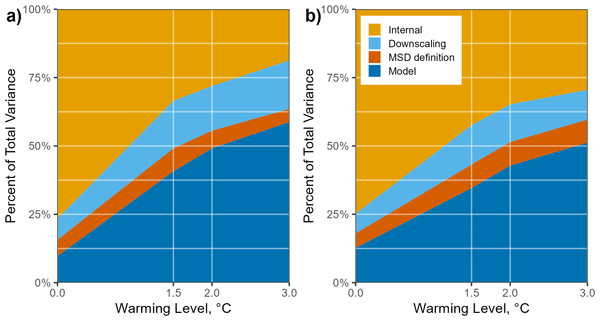
Abstract. The Central American mid-summer drought (MSD) is a defining precipitation pattern within the regional hydrologic system linked to water and food security. Past changes and future projections in the MSD show a strong sensitivity to how the MSD is defined. The question then arises as to whether multiple definitions should be considered to capture the uncertainty in projected impacts as climate warming continues and a need to understand the impacts on regional hydrology persists. This study uses an ensemble of climate models downscaled over Nicaragua using two methods, global warming levels up to 3 °C, and different definitions of the MSD to characterize the contributions to total uncertainty of each component. Results indicate that the MSD definition contributes the least to total uncertainty, explaining 5–8 % of the total. At the same time, evidence suggests a shift of the MSD to later in the year. As warming progresses, total uncertainty is increasingly dominated by variability among climate models. While not a dominant source of uncertainty, downscaling method adds approximately 10–15 % to total uncertainty. Future studies of this phenomenon should include an ensemble of climate models and can take advantage of archives of downscaled data to adequately capture uncertainty in hydrologic impacts. This approach could serve as a template to quantify the relative importance of uncertainty for projections of other precipitation-driven phenomena in different geographic contexts.
-
Notice on discussion status
The requested preprint has a corresponding peer-reviewed final revised paper. You are encouraged to refer to the final revised version.
-
Preprint
(1559 KB)
-
The requested preprint has a corresponding peer-reviewed final revised paper. You are encouraged to refer to the final revised version.
- Preprint
(1559 KB) - Metadata XML
- BibTeX
- EndNote
- Final revised paper


Journal article(s) based on this preprint
Interactive discussion
Status: closed
-
RC1: 'Comment on egusphere-2025-1650', Anonymous Referee #1, 24 Aug 2025
-
AC1: 'Reply on RC1', Edwin Maurer, 17 Oct 2025
Thank you for the detailed reading and thoughtful comments. Please see the attached pdf for detailed responses. Note that the file includes responses to both sets of reviewer comments, since some comments overlapped and in some cases our responses reference our responses to the other reviewer.
-
AC1: 'Reply on RC1', Edwin Maurer, 17 Oct 2025
-
RC2: 'Comment on egusphere-2025-1650', Anonymous Referee #2, 07 Sep 2025
This manuscript provides a valuable and scientifically sound analysis of uncertainty partitioning for the Central American midsummer drought (MSD). Its novel contribution is the explicit inclusion of MSD definition as an additional source of uncertainty, and it also demonstrates the value of using a warming-level framing. While this latter approach has been established in recent climate assessments, applying it to hydrologic partitioning shows how it can reduce sensitivity to model selection or emissions scenarios.
The study is methodologically robust and relevant to both scientific understanding and decision-oriented science. With improvements to presentation clarity (streamlined writing, clearer figure formatting, consolidated summaries of uncertainty sources) and a stronger connection to prior literature, the paper would make a strong contribution to HESS.
Please see the attached document for the full review. After refinements to address the comments in the attachment, I would consider the scores for all criteria to be excellent.
-
AC1: 'Reply on RC1', Edwin Maurer, 17 Oct 2025
Thank you for the detailed reading and thoughtful comments. Please see the attached pdf for detailed responses. Note that the file includes responses to both sets of reviewer comments, since some comments overlapped and in some cases our responses reference our responses to the other reviewer.
-
AC1: 'Reply on RC1', Edwin Maurer, 17 Oct 2025


Interactive discussion
Status: closed
-
RC1: 'Comment on egusphere-2025-1650', Anonymous Referee #1, 24 Aug 2025
This paper performs a variance decomposition analysis to identify important sources of uncertainty in projections of the Central American mid-summer drought (MSD). The novel contribution of this work is to include the definition of the MSD as an additional source of uncertainty. The paper is well-written, scientifically sound, and the motivation and framework have broad relevance across other impact areas. I have a few suggestions that I feel would improve the manuscript.
Main points:
- My main question concerns the apparent mismatch between Figures 4 & 5 and Figure 6. The distribution of white (meaning NULL) grid points in Figures 4 & 5 would suggest that the MSD definition has a considerable impact on its frequency and spatial extent, yet this doesn’t show in the variance decomposition results of Figure 7. As I understand, the variance decomposition results for intensity and duration are conditional on the MSD occurring since the authors drop all NULL values, but I wonder whether a frequency-based metric might show qualitatively different patterns. As the authors are likely aware, frequency is commonly considered in tandem with intensity and duration, and often required to form a full understanding of impacts. Would the authors be able to repeat the analysis for a suitably-defined frequency metric? Or if not, sharpen the discussion of the apparent mismatch between Figures 4-5 and the decomposition results in Figure 7?
- The current approach to perturbing the MSD definition seems somewhat arbitrary. I would like the authors to provide some additional context regarding these alternate definitions. For example, does shifting the window by 14 days make MSD impacts more/less relevant for different types of agriculture in the region? Or do these reflect different definitions used the existing literature? More broadly, why is shifting the window preferred over making changes to the minimum duration or minimum intensity, which seem at least as important?
- In the paragraph beginning on line 71, I do not think that the impact definition should be conflated with uncertainty in its simulation across (e.g.) different hydrologic models. For example, when simulating hydrologic or agricultural drought, different hydrologic models will show varying responses for the same drought definition, while different drought definitions will manifest as an additional uncertainty source for each individual model. I think it would be worth more explicitly separating these sources of uncertainty in this paragraph.
Minor points:
- Line 88: Looks like a missing word: “A recent study MSD explored the variability…”
- Line 114: I would suggest changing “climate model precipitation trends of the climate models” to “precipitation trends of the climate models.”
- Line 110: It may be worth specifying that you are using the CMIP6 version of the NASA-NEX dataset, given there is also a CMIP5 version.
- Line 120,121: The SSP scenario should be 5-8.5, not 5-85.
- In Figure 3, do the historical values come from the historical climate model simulations, rather than observational data? It would be worth stating this explicitly.
- Figure 6 is instructive but I think would benefit from showing the marginal distributions as KDEs along each axis.
Citation: https://doi.org/10.5194/egusphere-2025-1650-RC1 -
AC1: 'Reply on RC1', Edwin Maurer, 17 Oct 2025
Thank you for the detailed reading and thoughtful comments. Please see the attached pdf for detailed responses. Note that the file includes responses to both sets of reviewer comments, since some comments overlapped and in some cases our responses reference our responses to the other reviewer.
-
RC2: 'Comment on egusphere-2025-1650', Anonymous Referee #2, 07 Sep 2025
This manuscript provides a valuable and scientifically sound analysis of uncertainty partitioning for the Central American midsummer drought (MSD). Its novel contribution is the explicit inclusion of MSD definition as an additional source of uncertainty, and it also demonstrates the value of using a warming-level framing. While this latter approach has been established in recent climate assessments, applying it to hydrologic partitioning shows how it can reduce sensitivity to model selection or emissions scenarios.
The study is methodologically robust and relevant to both scientific understanding and decision-oriented science. With improvements to presentation clarity (streamlined writing, clearer figure formatting, consolidated summaries of uncertainty sources) and a stronger connection to prior literature, the paper would make a strong contribution to HESS.
Please see the attached document for the full review. After refinements to address the comments in the attachment, I would consider the scores for all criteria to be excellent.
-
AC1: 'Reply on RC1', Edwin Maurer, 17 Oct 2025
Thank you for the detailed reading and thoughtful comments. Please see the attached pdf for detailed responses. Note that the file includes responses to both sets of reviewer comments, since some comments overlapped and in some cases our responses reference our responses to the other reviewer.
-
AC1: 'Reply on RC1', Edwin Maurer, 17 Oct 2025
Peer review completion


Journal article(s) based on this preprint
Viewed
| HTML | XML | Total | BibTeX | EndNote | |
|---|---|---|---|---|---|
| 2,690 | 102 | 31 | 2,823 | 65 | 81 |
- HTML: 2,690
- PDF: 102
- XML: 31
- Total: 2,823
- BibTeX: 65
- EndNote: 81
Viewed (geographical distribution)
| Country | # | Views | % |
|---|
| Total: | 0 |
| HTML: | 0 |
| PDF: | 0 |
| XML: | 0 |
- 1
Iris Stewart
The requested preprint has a corresponding peer-reviewed final revised paper. You are encouraged to refer to the final revised version.
- Preprint
(1559 KB) - Metadata XML
This paper performs a variance decomposition analysis to identify important sources of uncertainty in projections of the Central American mid-summer drought (MSD). The novel contribution of this work is to include the definition of the MSD as an additional source of uncertainty. The paper is well-written, scientifically sound, and the motivation and framework have broad relevance across other impact areas. I have a few suggestions that I feel would improve the manuscript.
Main points:
Minor points: