
the Creative Commons Attribution 4.0 License.
the Creative Commons Attribution 4.0 License.
 | 24 Apr 2025
New experiments to probe the role of fractures in bedrock on river erosion rate and processes
Abstract. River erosion via abrasion and plucking is a fundamental process that impacts, among others, landscape evolution, sediment transport, and hillslope dynamics. It results from complex interactions between climate, tectonics, topography and the erodibility of bedrock. Despite its significant role, bedrock erodibility remains poorly understood as it is thought to aggregate several parameters. Among these, fractures in bedrock are assumed to exert a strong control over erosion and thus, on landscape evolution. However, there is no systematic study of the impact of fracture geometry and density on bedrock river erosion.
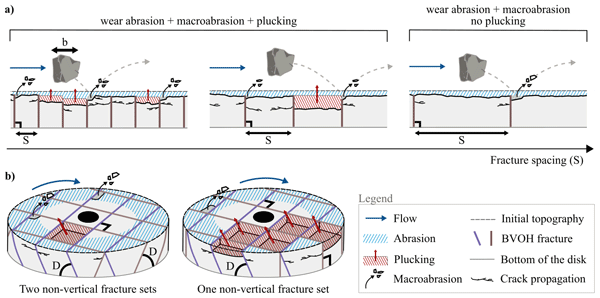
Due to the complex interactions at play, we investigate this question via an experimental approach. We develop an erosion mill apparatus designed to erode a fractured concrete disk with a diameter of 17 cm. We simulate fractures by embedding a 3D-printed plastic mesh in the concrete, using BVOH—a plastic that softens in cold water—creating mechanical heterogeneities with a controlled pattern. We explore 10 different geometries and run 4 additional experiments without fractures for control. We record the topographic evolution every 2 minutes by photogrammetry and derive erosion maps by measuring elevation changes between successive scans. To our knowledge, this is the first study of its kind. Our results show that while fractures influence the relative contributions of abrasion and plucking, no clear relationship emerges between average erosion rates and fracture density or dip angle. However, we observe that the occurrence of plucking is related to the density and the dip angles of fractures, and is favoured by intermediate density that scales with the size of the impactors, and intermediate dip angle that ease the removal of blocks. We suggest that the main impact of plucking is to change the location of erosion, increasing the eroded surface area rather than accelerating overall erosion rates. However, but as plucking accounts for at most one-third of the total erosion, its occurrence does not significantly affect average erosion rates. These findings emphasize the role of fractures on erosion mode and location rather than erosion rates, and highlight the need to further explore the impact of fractures on riverbed erosion.
-
Notice on discussion status
The requested preprint has a corresponding peer-reviewed final revised paper. You are encouraged to refer to the final revised version.
-
Preprint
(2096 KB)
-
Supplement
(1951 KB)
-
The requested preprint has a corresponding peer-reviewed final revised paper. You are encouraged to refer to the final revised version.
- Preprint
(2096 KB) - Metadata XML
-
Supplement
(1951 KB) - BibTeX
- EndNote
- Final revised paper


Journal article(s) based on this preprint
Interactive discussion
Status: closed
- RC1: 'Comment on egusphere-2025-1541', Alexander Neely, 01 May 2025
- RC2: 'Comment on egusphere-2025-1541', Anonymous Referee #2, 10 Jun 2025
- AC1: 'Comment on egusphere-2025-1541', Marion Fournereau, 18 Jul 2025


Interactive discussion
Status: closed
- RC1: 'Comment on egusphere-2025-1541', Alexander Neely, 01 May 2025
- RC2: 'Comment on egusphere-2025-1541', Anonymous Referee #2, 10 Jun 2025
- AC1: 'Comment on egusphere-2025-1541', Marion Fournereau, 18 Jul 2025
Peer review completion


Journal article(s) based on this preprint
Viewed
| HTML | XML | Total | Supplement | BibTeX | EndNote | |
|---|---|---|---|---|---|---|
| 850 | 181 | 32 | 1,063 | 83 | 63 | 73 |
- HTML: 850
- PDF: 181
- XML: 32
- Total: 1,063
- Supplement: 83
- BibTeX: 63
- EndNote: 73
Viewed (geographical distribution)
| Country | # | Views | % |
|---|
| Total: | 0 |
| HTML: | 0 |
| PDF: | 0 |
| XML: | 0 |
- 1
Marion Fournereau
Laure Guerit
Philippe Steer
Jean-Jacques Kermarrec
Paul Leroy
Christophe Lanos
Hélène Hivert
Claire Astrié
Dimitri Lague
The requested preprint has a corresponding peer-reviewed final revised paper. You are encouraged to refer to the final revised version.
- Preprint
(2096 KB) - Metadata XML
-
Supplement
(1951 KB) - BibTeX
- EndNote
- Final revised paper
I attach suggestions in the pdf.
Good luck with the rest of the submission and review!
Don't hesitate to contact if you have questions.