
the Creative Commons Attribution 4.0 License.
the Creative Commons Attribution 4.0 License.
 | 01 Apr 2025
Characterizing rockfall hazard with an integrated kinematic analysis and runout model: Skagway, Alaska, USA
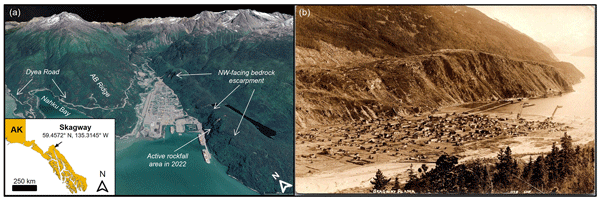
Abstract. Rockfall is common in steep terrain and poses a hazard to nearby communities. While rockfall triggering mechanisms are highly variable and difficult to quantify, the susceptibility of rock slopes to planar, wedge, or toppling failure can be readily assessed using kinematic analysis. As such, valley slopes with favourable joint orientations exhibit high rockfall susceptibility although the potential for rockfall runout to impact infrastructure and public safety depends on the morphology of downslope terrain. Integrating rockfall susceptibility and runout models with maps of talus deposits accumulated from past rockfall events is an effective combination of tools to inform mitigation but can be difficult to realize across extensive areas. Here, we combine these methods with a historic rockfall inventory to assess rockfall hazard in the steep and forested postglacial valleys proximal to Skagway, AK, where recent rockfall activity has imperilled public safety, infrastructure, and tourism. Our field investigations identified two steeply dipping orthogonal joint sets that favour toppling failure along NW-facing hillslopes in the lower Skagway River valley as well as the NW-facing valleys that bound nearby Dyea Bay and Nahku Bay. We used new and existing lidar data and >300 field-derived joint orientations to inform a kinematic toppling failure model that identifies likely zones of rock toppling. The predicted source zones are positioned upslope of abundant talus slopes that we mapped from field observations and lidar analyses. Along the prominent ridgeline on the eastern margin of Skagway, we used RAMMS:Rockfall to model nearly 200,000 rockfall runout events for four scenarios that account for variations in clast size and ground cover. The runout predictions highlight distinct zones of low and high rockfall hazard along the ridgeline that result from changes in hillslope morphology set by the combined influence of joint orientations and the pattern of glacial erosion. High-hazard segments of the ridgeline exhibit distinct bedrock escarpments and slope-spanning talus slopes that result from the accumulation of rockfall activity over millennia. Our findings reveal controls on past and future rockfall activity and can be used to inform mitigative measures.
-
Notice on discussion status
The requested preprint has a corresponding peer-reviewed final revised paper. You are encouraged to refer to the final revised version.
-
Preprint
(3104 KB)
-
Supplement
(26 KB)
-
The requested preprint has a corresponding peer-reviewed final revised paper. You are encouraged to refer to the final revised version.
- Preprint
(3104 KB) - Metadata XML
-
Supplement
(26 KB) - BibTeX
- EndNote
- Final revised paper


Journal article(s) based on this preprint
Interactive discussion
Status: closed
-
RC1: 'Comment on egusphere-2025-1168', Dominik May, 30 Apr 2025
-
AC1: 'Reply on RC1', Joshua Roering, 28 Jun 2025
These reviewer comments are exceptionally comprehensive and incredibly helpful in terms of improving details as well as clarifying the big picture. Many, many thanks.
In the attached pdf file, we've added comments to each individual reviewer comments that summarizes our response and plans for addressing the issues raised.
-
AC1: 'Reply on RC1', Joshua Roering, 28 Jun 2025
-
RC2: 'Comment on egusphere-2025-1168', Anonymous Referee #2, 26 May 2025
The manuscript is well organised and, except for missing information about local places in maps, also very well presented work focused on the rockfall hazard of a small area around a turistically important town in Alaska. The used methods are standard with widely used approach and software used for rockfall hazard assessment. Nevertheless, authors failed to provide enough evidence about how representative the structural data obtained from the limited part of the study area is for the rest of it. The literature review is missing some important previous work on this topic e.g., from Europe. The results combine geomorphological mapping with the rockfall hazard assessment in a meaningful interpretation, but have a nature of small-scale local study, which contribution to the research topic on a global scale is limited. Considering this and a lack of methodological innovation, the impact of this study for a global audience seems questionable.
Please consider the detailed comments in the attached file.
-
AC2: 'Reply on RC2', Joshua Roering, 28 Jun 2025
Many thanks for the very helpful and constructive comments. The need to incorporate references from European studies is well taken and we've generated a revised literature review of the relevant work. With respect to the two major comments regarding representative joint/structural data and the need to move beyond a small-scale local study, we've done the following:
1. we revisited the study area in June 2025 and gathered joint orientation data at 12 new locations that span the entire study area. in doing so, we're able to show the remarkable consistency of the primary joint orientations which support the approach we've taken here for the kinematic analysis.
2. the comment about moving beyond a local study is well put and we agree that revisiting the primary research questions is necessary. To do this, we've rewritten the last introduction paragraph to focus on the conceptual approach and model novelty. We've also performed an additional analysis of the topography that uses wavelets to quantify variations in the characteristic wavelength of the topography. This analysis shows where and why rockfall propagation is diminished due to topographic controls on dissipation of energy during runout. In essence, particular wavelengths of topography are effective as dissipating rockfall runout. In addition, we've added a climate analysis of the AKDOT database to test controls on triggering. We've also more rigorously correlated the correspondence of toppling susceptible zones with downslope talus deposits. Taken together, these revisions and new methods should alleviate the concerns about the lack of generality of our results and instead emphasize innovative approaches to addressing hazard in a heavily visited tourist area.Please see specific comments to review comments in the attached pdf file.
-
AC2: 'Reply on RC2', Joshua Roering, 28 Jun 2025
Peer review completion


Interactive discussion
Status: closed
-
RC1: 'Comment on egusphere-2025-1168', Dominik May, 30 Apr 2025
The manuscript offers a promising work towards a quantitative but simple assessment of rockfall sources that has potential to be valuable in geomorphology and natural hazards. There are several aspects that should be substantially improved in order to exploit the potential of this work. The details to be improved are listed in the supplement and can be summarized as a need for a more conceptual and quantitative framework in order to make the work easier to reproduce and to underpin it with a stronger numerical foundation.
-
AC1: 'Reply on RC1', Joshua Roering, 28 Jun 2025
These reviewer comments are exceptionally comprehensive and incredibly helpful in terms of improving details as well as clarifying the big picture. Many, many thanks.
In the attached pdf file, we've added comments to each individual reviewer comments that summarizes our response and plans for addressing the issues raised.
-
AC1: 'Reply on RC1', Joshua Roering, 28 Jun 2025
-
RC2: 'Comment on egusphere-2025-1168', Anonymous Referee #2, 26 May 2025
The manuscript is well organised and, except for missing information about local places in maps, also very well presented work focused on the rockfall hazard of a small area around a turistically important town in Alaska. The used methods are standard with widely used approach and software used for rockfall hazard assessment. Nevertheless, authors failed to provide enough evidence about how representative the structural data obtained from the limited part of the study area is for the rest of it. The literature review is missing some important previous work on this topic e.g., from Europe. The results combine geomorphological mapping with the rockfall hazard assessment in a meaningful interpretation, but have a nature of small-scale local study, which contribution to the research topic on a global scale is limited. Considering this and a lack of methodological innovation, the impact of this study for a global audience seems questionable.
Please consider the detailed comments in the attached file.
-
AC2: 'Reply on RC2', Joshua Roering, 28 Jun 2025
Many thanks for the very helpful and constructive comments. The need to incorporate references from European studies is well taken and we've generated a revised literature review of the relevant work. With respect to the two major comments regarding representative joint/structural data and the need to move beyond a small-scale local study, we've done the following:
1. we revisited the study area in June 2025 and gathered joint orientation data at 12 new locations that span the entire study area. in doing so, we're able to show the remarkable consistency of the primary joint orientations which support the approach we've taken here for the kinematic analysis.
2. the comment about moving beyond a local study is well put and we agree that revisiting the primary research questions is necessary. To do this, we've rewritten the last introduction paragraph to focus on the conceptual approach and model novelty. We've also performed an additional analysis of the topography that uses wavelets to quantify variations in the characteristic wavelength of the topography. This analysis shows where and why rockfall propagation is diminished due to topographic controls on dissipation of energy during runout. In essence, particular wavelengths of topography are effective as dissipating rockfall runout. In addition, we've added a climate analysis of the AKDOT database to test controls on triggering. We've also more rigorously correlated the correspondence of toppling susceptible zones with downslope talus deposits. Taken together, these revisions and new methods should alleviate the concerns about the lack of generality of our results and instead emphasize innovative approaches to addressing hazard in a heavily visited tourist area.Please see specific comments to review comments in the attached pdf file.
-
AC2: 'Reply on RC2', Joshua Roering, 28 Jun 2025
Peer review completion
Journal article(s) based on this preprint
Viewed
| HTML | XML | Total | Supplement | BibTeX | EndNote | |
|---|---|---|---|---|---|---|
| 2,542 | 841 | 126 | 3,509 | 110 | 94 | 132 |
- HTML: 2,542
- PDF: 841
- XML: 126
- Total: 3,509
- Supplement: 110
- BibTeX: 94
- EndNote: 132
Viewed (geographical distribution)
| Country | # | Views | % |
|---|
| Total: | 0 |
| HTML: | 0 |
| PDF: | 0 |
| XML: | 0 |
- 1
Ian D. Wachino

Reuben Cash
Annette I. Patton
The requested preprint has a corresponding peer-reviewed final revised paper. You are encouraged to refer to the final revised version.
- Preprint
(3104 KB) - Metadata XML
-
Supplement
(26 KB) - BibTeX
- EndNote
- Final revised paper
The manuscript offers a promising work towards a quantitative but simple assessment of rockfall sources that has potential to be valuable in geomorphology and natural hazards. There are several aspects that should be substantially improved in order to exploit the potential of this work. The details to be improved are listed in the supplement and can be summarized as a need for a more conceptual and quantitative framework in order to make the work easier to reproduce and to underpin it with a stronger numerical foundation.