
the Creative Commons Attribution 4.0 License.
the Creative Commons Attribution 4.0 License.
 | 18 Jul 2024
Isotopic exchangeability reveals that soil phosphate is mobilised by carboxylate anions whereas acidification had the reverse effect
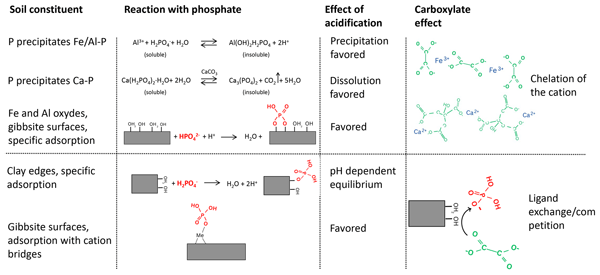
Abstract. Mineral P is an increasingly scarce resource and therefore the mobilisation of legacy soil P must be optimised to maintain soil fertility. We have used isotopic exchangeability to probe the lability of native soil P in four contrasting soils following acidification and the addition of carboxylate anions (citrate and oxalate) in soil suspension. Acidification tended to cause immobilisation of soil P, but this was attributed to a salt effect. Addition of both citrate and oxalate led to marked increases in mobilisation of soil P. This would result from both competition between carboxylate and phosphate ions at adsorption sites and chelation of charge compensating cations. The carboxylate effects were similar at each level of acidification, indicating that effects were largely additive. This is not true for the most calcareous soil where calcium oxalate may have been precipitated at the highest oxalate addition. Promoting carboxylate anions in soil by soil amendment or the use of crops that exude large amounts of such organic anions is a promising approach to improve soil P availability.
-
Notice on discussion status
The requested preprint has a corresponding peer-reviewed final revised paper. You are encouraged to refer to the final revised version.
-
Preprint
(617 KB)
-
The requested preprint has a corresponding peer-reviewed final revised paper. You are encouraged to refer to the final revised version.
- Preprint
(617 KB) - Metadata XML
- BibTeX
- EndNote
- Final revised paper


Journal article(s) based on this preprint
Interactive discussion
Status: closed
-
RC1: 'Comment on egusphere-2024-1791', Anonymous Referee #1, 09 Aug 2024
- AC1: 'Reply on RC1', Siobhan Staunton, 30 Sep 2024
-
RC2: 'Comment on egusphere-2024-1791', Anonymous Referee #2, 01 Dec 2024
This short communication describes some important research that represents a novel contribution to advancing understanding of key properties and processes that influence the fate and bioavailability of phosphorus in soil-plant systems. The rationale for the study, together with the methodology employed, were appropriate and clearly justified and described. The results as presented in Figure 1 clearly demonstrated that the presence of citrate and oxalate anions had a significant impact on the potential bioavailability of inorganic phosphorus adsorbed on soil oxide surfaces, and confirmed the role and importance of soil acidity. However, I simply could not comprehend the meaning or significance of the data presented in Figure 2, and strongly recommend that it be omitted from the manuscript.
Citation: https://doi.org/10.5194/egusphere-2024-1791-RC2 -
AC2: 'Reply on RC2', Siobhan Staunton, 15 Jan 2025
This short communication describes some important research that represents a novel contribution to advancing understanding of key properties and processes that influence the fate and bioavailability of phosphorus in soil-plant systems. The rationale for the study, together with the methodology employed, were appropriate and clearly justified and described. The results as presented in Figure 1 clearly demonstrated that the presence of citrate and oxalate anions had a significant impact on the potential bioavailability of inorganic phosphorus adsorbed on soil oxide surfaces, and confirmed the role and importance of soil acidity. However, I simply could not comprehend the meaning or significance of the data presented in Figure 2, and strongly recommend that it be omitted from the manuscript.
The role of the presentation of our findings in Figure 2 was to unravel the complex interacting effects of pH, ionic strength and carboxylate anions. However we agree that is does not clarify our thinking. We have removed the figure. We have also redrawn Figure 1 and rearranged Table 1 to present data from soils in order of increasing pH, and buffer capacity.
Citation: https://doi.org/10.5194/egusphere-2024-1791-AC2
-
AC2: 'Reply on RC2', Siobhan Staunton, 15 Jan 2025
Peer review completion


Interactive discussion
Status: closed
-
RC1: 'Comment on egusphere-2024-1791', Anonymous Referee #1, 09 Aug 2024
Revision of the manuscript: Isotopic exchangeability reveals that soil phosphate is mobilised by carboxylate anions whereas acidification had the reverse effect. Submitted to Egusphere by S. Staunton and C. Pistocchi.
The work addresses the explanation of the mechanisms underpinning the release of phosphate from soil solid phases by the anions of organic acids commonly released in plant rhizosphere, in particular, oxalate and citrate.
The topic is not novel itself, being historically addressed by several publications of soil chemistry, (e.g., Barrow NJ (1984), J Soil Sci 35:283–297), some of which by the same Author (Staunton and Leprince (1996), Eur. J. Soil Sci., 47:231-239) as the Authors properly explain in their Introduction. However, the question is here afforded for the first time using 32P isotopic exchange, thus providing reliable information on P exchangeability; moreover, the experiment is designed to disentangle the contributions of the ionic strength of the solution, the changes in pH and the complexing/competing ability of the organic ions.
The experimental design is simple but smartly composed, well described and adequate for answering the research questions. The results are elaborated to evidence the differences among different soil samples and treatments induced by the variables of interest (They probably express the most suitable way to evidence the studied effects, however the addition of a table with the “raw data” od P exchange at each pH in the different soils would be nice to read). The different behaviors of the soils are not always easy to explain, however the given explanations are reliable.
The writing style is clear and concise, in line the experimental setup and the data presentation in the tables and figures.
A few minor specific comments are reported below:
Page 2, line 24: “optimization of legacy soil P”. May it be: “optimization of legacy soil P availability”?
Page 5, line 128. Suggestion: could you add a short explanation about the mechanisms of “salt effect” vs “pH effect”?
Citation: https://doi.org/10.5194/egusphere-2024-1791-RC1 - AC1: 'Reply on RC1', Siobhan Staunton, 30 Sep 2024
-
RC2: 'Comment on egusphere-2024-1791', Anonymous Referee #2, 01 Dec 2024
This short communication describes some important research that represents a novel contribution to advancing understanding of key properties and processes that influence the fate and bioavailability of phosphorus in soil-plant systems. The rationale for the study, together with the methodology employed, were appropriate and clearly justified and described. The results as presented in Figure 1 clearly demonstrated that the presence of citrate and oxalate anions had a significant impact on the potential bioavailability of inorganic phosphorus adsorbed on soil oxide surfaces, and confirmed the role and importance of soil acidity. However, I simply could not comprehend the meaning or significance of the data presented in Figure 2, and strongly recommend that it be omitted from the manuscript.
Citation: https://doi.org/10.5194/egusphere-2024-1791-RC2 -
AC2: 'Reply on RC2', Siobhan Staunton, 15 Jan 2025
This short communication describes some important research that represents a novel contribution to advancing understanding of key properties and processes that influence the fate and bioavailability of phosphorus in soil-plant systems. The rationale for the study, together with the methodology employed, were appropriate and clearly justified and described. The results as presented in Figure 1 clearly demonstrated that the presence of citrate and oxalate anions had a significant impact on the potential bioavailability of inorganic phosphorus adsorbed on soil oxide surfaces, and confirmed the role and importance of soil acidity. However, I simply could not comprehend the meaning or significance of the data presented in Figure 2, and strongly recommend that it be omitted from the manuscript.
The role of the presentation of our findings in Figure 2 was to unravel the complex interacting effects of pH, ionic strength and carboxylate anions. However we agree that is does not clarify our thinking. We have removed the figure. We have also redrawn Figure 1 and rearranged Table 1 to present data from soils in order of increasing pH, and buffer capacity.
Citation: https://doi.org/10.5194/egusphere-2024-1791-AC2
-
AC2: 'Reply on RC2', Siobhan Staunton, 15 Jan 2025
Peer review completion
Journal article(s) based on this preprint
Viewed
| HTML | XML | Total | BibTeX | EndNote | |
|---|---|---|---|---|---|
| 1,476 | 454 | 271 | 2,201 | 101 | 184 |
- HTML: 1,476
- PDF: 454
- XML: 271
- Total: 2,201
- BibTeX: 101
- EndNote: 184
Viewed (geographical distribution)
| Country | # | Views | % |
|---|
| Total: | 0 |
| HTML: | 0 |
| PDF: | 0 |
| XML: | 0 |
- 1
Siobhan Staunton

Chiara Pistocchi
The requested preprint has a corresponding peer-reviewed final revised paper. You are encouraged to refer to the final revised version.
- Preprint
(617 KB) - Metadata XML
Revision of the manuscript: Isotopic exchangeability reveals that soil phosphate is mobilised by carboxylate anions whereas acidification had the reverse effect. Submitted to Egusphere by S. Staunton and C. Pistocchi.
The work addresses the explanation of the mechanisms underpinning the release of phosphate from soil solid phases by the anions of organic acids commonly released in plant rhizosphere, in particular, oxalate and citrate.
The topic is not novel itself, being historically addressed by several publications of soil chemistry, (e.g., Barrow NJ (1984), J Soil Sci 35:283–297), some of which by the same Author (Staunton and Leprince (1996), Eur. J. Soil Sci., 47:231-239) as the Authors properly explain in their Introduction. However, the question is here afforded for the first time using 32P isotopic exchange, thus providing reliable information on P exchangeability; moreover, the experiment is designed to disentangle the contributions of the ionic strength of the solution, the changes in pH and the complexing/competing ability of the organic ions.
The experimental design is simple but smartly composed, well described and adequate for answering the research questions. The results are elaborated to evidence the differences among different soil samples and treatments induced by the variables of interest (They probably express the most suitable way to evidence the studied effects, however the addition of a table with the “raw data” od P exchange at each pH in the different soils would be nice to read). The different behaviors of the soils are not always easy to explain, however the given explanations are reliable.
The writing style is clear and concise, in line the experimental setup and the data presentation in the tables and figures.
A few minor specific comments are reported below:
Page 2, line 24: “optimization of legacy soil P”. May it be: “optimization of legacy soil P availability”?
Page 5, line 128. Suggestion: could you add a short explanation about the mechanisms of “salt effect” vs “pH effect”?